Top 8 Programmatic Advertising Platforms Retail Marketers Trust
On this page
- The best platforms for programmatic advertising in retail differ less on reach than on whether onsite and offsite report into one system:
- NEXUS: An operating system for retail media, with the ad units, integrations, and clean room already wired together. Operators can launch white-labeled in under 30 days.
- Amazon DSP: For Amazon purchase data. You buy it for that, not the interface.
- The Trade Desk: For agency desks already buying open market at scale. No onsite retail media.
- Criteo: For reaching shoppers across many retailers at once.

The best platforms for programmatic advertising in retail are judged on one thing in the end: whether their numbers survive contact with your other reports.
Your DSP says the campaign worked. The retailer’s console says something else. Nobody’s lying. The numbers come from two systems that were never built to talk to each other, and you’re the one who has to explain the gap.
Right now, most buyers split budgets by what each tool can do, not by where the shopper is. The solution is a single platform that runs both sides of the buy and reports them against one set of numbers.
In this guide, we cover the 8 best platforms for programmatic advertising in retail in 2026: what each one does well and where it breaks.
What Matters When Comparing the Best Programmatic Platforms in Retail
Five questions cut through the retail media advertising platforms feature grid:
- Can you take your audiences with you? A programmatic ad platform in retail that targets on its own commerce data but blocks export leaves your segments locked in. That caps how far one platform can carry a full plan.
- Are product ads in the same account? Sponsored products behave differently from open-market display. Buying them separately means two sets of numbers to reconcile every month.
- What can you see about fees and supply? Check the programmatic advertising platform pricing. Ask for percentage-of-media disclosure. Ask about ads.txt and sellers.json. Ask whether you get impression-level logs.
- How fresh is the reporting? Hourly data lets you fix a campaign mid-flight. Daily data lets you write a post-mortem.
- Which controls are on by default? Made-for-advertising exclusion, list sizes, and verification partners vary. Get it in writing.
NEXUS is one of the best platforms for programmatic advertising in retail that covers all five from one account.
The retail media networks vs DSP question also comes up early in every shortlist.
A DSP is buying software for brand media buyers. A retail media network is inventory and data an operator owns and sells. Plenty of retail teams need both. Few platforms cover both.
NEXUS acts as an Advertising OS that connects them. It gives retailers the infrastructure to monetize their own traffic and sell ad units, while allowing brand marketers to buy programmatic media against shopper data from a single account.
See how NEXUS runs this on your data
Everything in this article runs on NEXUS today. See the Programmatic Advertising Platform page.
8 Best Platforms for Programmatic Advertising in Retail, Compared
Here’s how the best programmatic advertising platforms in retail compare on the four things that define your media plan.
| # | Platform | Retail ad units | Shopper data | Channels | Reporting |
| 1 | NEXUS | Full catalog, native | ~300M profiles, native DCR, export allowed | Display, native, CTV, DOOH, audio, in-app, mobile | ~80 dimensions, hourly |
| 2 | Amazon DSP | Amazon onsite only | Amazon purchase data, no export | Display, video, CTV | Closed measurement |
| 3 | The Trade Desk | None | Partner retail media data | Display, video, CTV, audio, native, DOOH, mobile, in-app, ATV | Granular, partner clean rooms |
| 4 | Criteo | Onsite plus offsite, managed | Retailer network data | Display, native, CTV, video | Fixed schema |
| 5 | Google DV360 | None | Google audience and intent | Display, video, YouTube | Inside Google stack |
| 6 | StackAdapt | None | North America weighted | Display, native, video, CTV, audio, in-app, DOOH, mobile | Hourly |
| 7 | Kevel | APIs only | You supply it | Onsite only | Build your own |
| 8 | Topsort | Sponsored listings | Marketplace catalogue | Onsite only | Basic |
Here’s a detailed overview of the top programmatic platforms in retail.
Note: This programmatic advertising platforms list is not a ranking. Each platform is strongest for a different buyer.
1. NEXUS: Unified Retail Media and Programmatic Platform
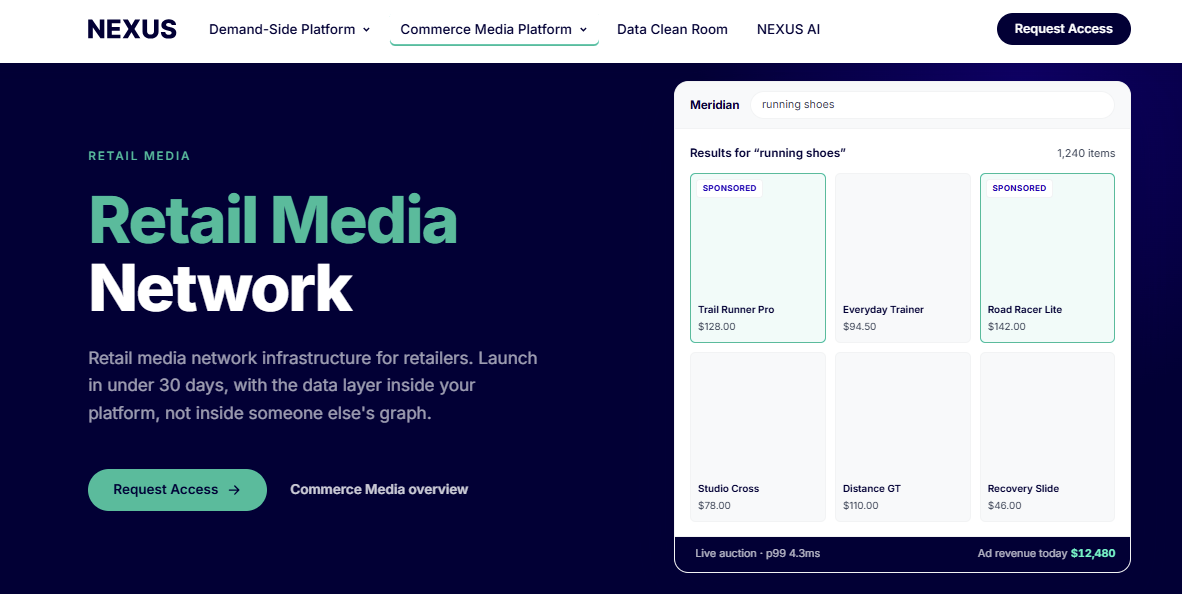
NEXUS is a Commerce Media Platform that runs media buying and retail media infrastructure on one stack. Buying clears 5M+ peak QPS at around 100 ms median bid latency, across 70+ supply integrations.
The ad unit catalog covers sponsored products and listings, sponsored brands, onsite display, and offsite extension. Operators can launch white-labeled in under 30 days with a full operator admin surface.
This is what you get:
- Seven channels: display, native, CTV, DOOH, audio, in-app, mobile
- Six targeting dimensions: geo, behavioral, contextual, custom, lookalike, retargeting
- Native DCR; operator audience + NEXUS DSP graph
- Operator admin surface + operator-branded white-label theming
- Two production AI workflows for bid optimization and audience prediction
- Pre-built integrations with the major ecommerce platforms: Shopify, BigCommerce, Magento, Salesforce Commerce, custom API
Downsides
- NEXUS is built for running an end-to-end retail media business. If you just need a lightweight tool for basic sponsored ads, it’s probably more than you actually need.
Best for: Retail teams who want shopper data programmatic targeting, and their own ad inventory under one set of controls.
2. Amazon DSP: Programmatic Ad Platform for Retail
Amazon DSP buys across Amazon properties and its publisher network, including Prime Video and Fire TV. Targeting uses Amazon purchase and browsing data. Conversion reporting ties impressions back to Amazon purchases. Seat access is self-service or managed depending on spend.
Downsides
- Audience data cannot be exported
- Third-party inventory is thinner than an independent DSP
- You see less of the supply path and the fees
- No operator layer for running your own network
Best for: Brands whose sales are mostly on Amazon.
3. The Trade Desk: Independent DSP for Omnichannel Buying
The Trade Desk is an independent DSP built for open-market buying. Bid and supply path controls are exposed to the buyer. Retail data arrives through partnerships with retail media networks.
Downsides
- No product ad units, so onsite inventory needs a second platform
- Clean room work runs through partners
- Fee disclosure is limited
- Minimum spend commitments apply
Best for: High-volume open-market buying when onsite is already handled.
4. Criteo: Commerce Media and Retargeting Platform
Criteo is a commerce network with broad retailer reach. Covers onsite sponsored products, display, and offsite extensions. Advertisers reach retailer inventory through Criteo’s existing demand relationships. Mostly managed service.
Downsides
- The managed model gives buyers and operators less direct control over bidding and placement
- Channel coverage excludes DOOH and audio
- Reporting is fixed to Criteo’s schema, limiting custom dimensions
- Offsite buying is tied to Criteo’s own supply
Best for: Brands buying commerce media reach, and retailers willing to trade control for existing advertiser demand.
5. Google DV360: Programmatic Buying Across Google Inventory

DV360 connects Search and Shopping intent to display and YouTube, with the Google identity graph behind it. Retail targeting draws on Google audience data rather than retailer first-party data. For retail advertisers already running Google demand, the handoff is direct.
Downsides
- Limited third-party supply
- No native commerce ad units and no operator layer
- Walled-garden measurement limits independent verification
Best for: Teams whose retail demand already runs through Google Search and Shopping.
6. StackAdapt: Self-Serve DSP for Mid-Market Retail
StackAdapt is a self-service DSP running around 6M peak QPS, with named AI workflows for bid and budget optimization. Hourly reporting. Light enough for a small team to run without dedicated ad ops.
Downsides
- No commerce ad units
- Profile coverage leans North American, so international plans thin out
- Clean room runs through partners
Best for: Mid-market retail performance teams wanting campaign automation without an ad-ops build.
7. Kevel: Ad Serving Infrastructure for Retail Media
Kevel is an API toolkit for operators with engineering resources. You get the ad-serving and decisioning layer and build everything above it. Ad formats and placement logic are defined in code. Launch timelines depend on in-house engineering.
Downsides
- No pre-built ad units, advertiser dashboard, or reporting interface
- No clean room
- Launch time depends entirely on your team
- No demand-side activation
Best for: Retail evaluators with engineering capacity who want full control of the ad experience and accept a longer build.
8. Topsort: Auction Infrastructure for Ecommerce Sites
Auction-based sponsored listings for marketplaces. Setup is API-first, with onsite units live quickly. Auction logic is managed by Topsort. Sellers create campaigns through self-service.
Downsides
- Narrow offsite and channel coverage
- No clean room
- You will need a second platform for a full plan
Best for: Marketplaces monetizing seller listings as a first step into retail media.
Compare retail platforms with our team.
The best platforms for programmatic advertising in retail cover onsite monetization for operators and offsite demand for buyers from one seat, which is the shortest path to one set of numbers.
NEXUS was built to connect both sides of retail media advertising. It provides retail operators with the infrastructure to build and sell owned ad inventory and gives brand media buyers a DSP to activate shopper data offsite—all within one platform.
Request Access and compare NEXUS yourself.
Takeaways
- Decide which job you're buying for before you compare features. Reach is a supply problem; measurement is a data problem.
- Retail media networks sell access to one retailer's shoppers. DSPs buy audiences everywhere else. Whether you are an operator monetizing owned traffic or a brand buyer extending reach, look for a platform that handles both sides of the transaction. For the full buy-side view, see the best retail media platforms for brands.
- Product ads, CTV, and onsite placements rarely live in one seat. Check which platform covers more than one before you add another login.
- Shopper data programmatic targeting only pays off when you can activate the retailer's data, not just read it in a report.
- Count the systems, not the platforms. Every extra one adds a number you'll have to defend.
Frequently asked questions
NEXUS, if you want a single system built for both sides of retail media advertising. It allows retail operators to build and sell owned ad inventory while giving brand media buyers a DSP to activate shopper data offsite. Go with The Trade Desk when raw open-market buying is the primary goal, or Amazon DSP when nearly all your sales happen on Amazon.
Programmatic buys impressions across third-party publishers. Retail media sells ad placements on a retailer’s own site or app, targeted with its shopper data. NEXUS combines the two with a native Data Clean Room to ensure that the outcomes from onsite and offsite efforts make it into one report.
You need catalog data feeds, on-site behavior, transaction data, and an identity layer to connect exposure to a purchase. NEXUS handles Audience Activation with four identity solutions, around 300M person profiles, roughly 1,000 pre-built segments, and six targeting dimensions.
There is no cross-category benchmark, so pick your target CPM and CPA per placement, test, and scale those that achieve margin. NEXUS prices as a percentage of media spend, with a per-impression audit trail.
Yes, if you have enough conversion volume to optimize against and a clear CPA ceiling. NEXUS has no six-figure minimum commitment, so smaller teams can start on a single channel and add inventory as volume justifies it.



Request access to NEXUS
See how this runs on your own data. Request access to get started.
Request Access