Ad Network vs DSP in 2026: Which One Fits Your Campaigns?
On this page
- Ad network vs DSP: An ad network is an aggregator of publisher inventory. A DSP allows advertisers to bid across a variety of publishers and exchanges.
- Ad networks provide select placements. DSPs offer buyers more control over bidding and targeting.
- Costs depend on CPM, platform fees, and inventory.
- NEXUS has both buying models available on a common shared engine.

Ad network vs DSP decision is based on how much control your agency requires over a media purchase.
Media teams typically split their work between two models: DSPs, which provide bidding control across open exchanges but require ongoing management, and ad networks, which offer quick access to publisher packages.
Splitting campaigns between the two quickly becomes messy. Traders wind up battling broken frequency caps, juggling dashboards, and piecing together reports.
In this article, we compare the ad network vs DSP mechanics, costs, and day-to-day control of both.
Ad Network vs DSP: What Is the Difference?
Ad networks act as an intermediary between publishers and advertisers, collecting available inventory from various publishers, packaging it, and selling it to advertisers.
Depending on the ad network, advertisers may be able to choose from the available placements, audiences, and content categories, as well as specific formats in which the advertisement will be displayed.
A Demand-Side Platform (DSP) operates on the advertiser side. It connects to many supply-side platforms (SSPs) and ad exchanges that help advertisers evaluate and bid for impressions. See our guide on demand side platform vs supply side platform.
Here is how DSP vs ad network models compare:
| Technology | What it does | Who uses it |
| Ad network | Brings inventory from different publishers together and sells it to advertisers. | Advertisers and publishers |
| Ad exchange | Provides a marketplace where buyers and sellers trade ad impressions. | Advertisers and publishers |
| DSP (Demand-Side Platform) | Helps advertisers find, bid on, and buy ad inventory across different sources. | Advertisers and agencies |
| SSP (Supply-Side Platform) | Helps publishers manage their inventory and make it available to buyers. | Publishers |
| Ad server | Selects and delivers ads, then records when they are shown or clicked. | Advertisers and publishers |
For instance, Taboola and MGID are well known for native advertising and content recommendation. Our breakdowns of Taboola alternatives and MGID alternatives cover the trade-offs.
DSP platforms that offer tools for programmatic purchasing across linked supply sources include NEXUS, The Trade Desk, Google Display & Video 360 (DV360), and Adform.
See how NEXUS runs DSP and ad network buying on one engine.
How Does an Ad Network Work?
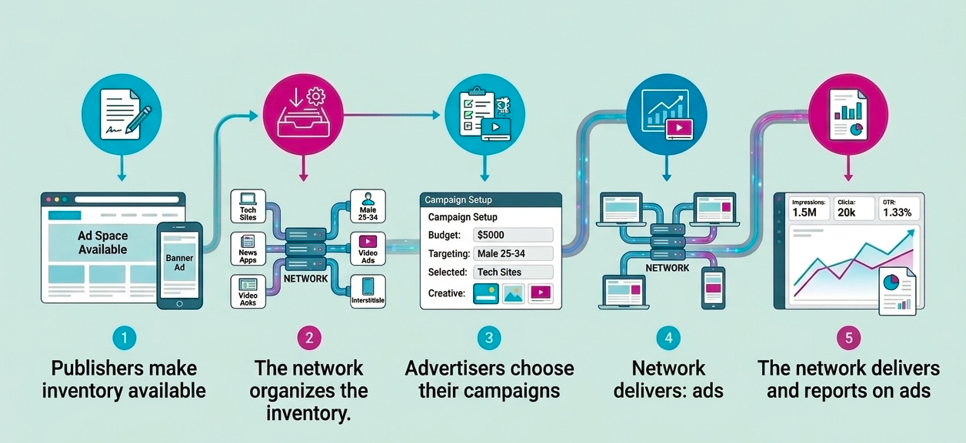
There are typically four steps in the process:
- Publishers make inventory available. Through direct contracts or other supply arrangements, websites and apps offer advertising placements.
- The network organizes the inventory. Publishers, content categories, audiences, and advertising formats can all be used to categorize available placements.
- Advertisers set up campaigns. Media buyers set campaign budgets and targeting specifications, choose appropriate inventory, and supply creative assets.
- The network delivers and reports on ads. Advertisers receive performance data based on the network’s reporting capabilities, and the network runs campaigns across eligible placements.
See how NEXUS runs this on your data
Everything in this article runs on NEXUS today. See the Demand-Side Platform page.
How Does a DSP Work?
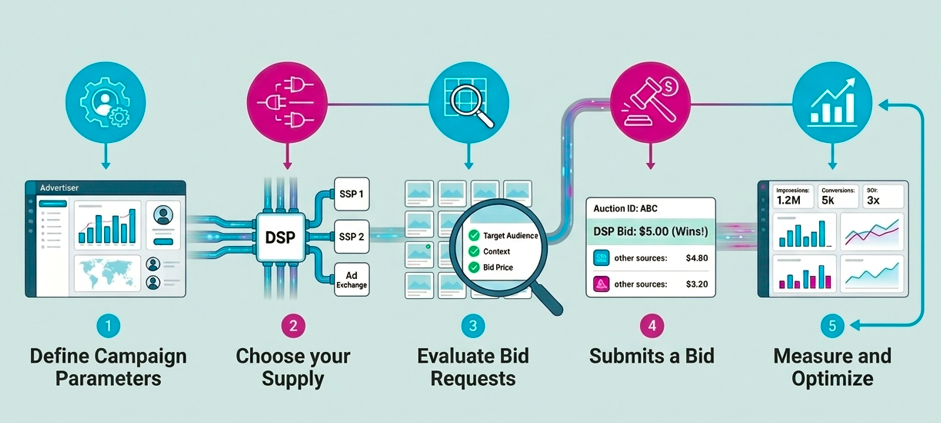
A Demand Side Platform (DSP) provides advertisers with access to inventory from multiple publishers and exchanges via a single buying interface.
Instead of choosing a set of placements from one network, the media buyer defines campaign requirements and lets the DSP evaluate individual advertising opportunities.
Here’s how a typical real-time bidding (RTB) transaction works:
- Define campaign parameters. The media buyer determines the budget, audience, geography, channels, bid settings, and other campaign parameters.
- Receive bid requests. The DSP receives advertising opportunities via integrations with SSPs and ad exchanges.
- Evaluate bid requests. If an impression is available, the DSP checks whether it fits the campaign’s targeting and delivery settings.
- Submit a bid. If the impression is eligible, the DSP can bid in the auction based on the campaign’s settings.
- Measure and optimize. The DSP logs the transaction and provides campaign data for reporting.
Media buyers don’t manually approve every impression. They set campaign rules, track performance, and adjust bids, budgets, targeting, and inventory selections as needed.
A self-serve DSP means advertisers or agencies can log in, create, and manage their own campaigns. This can work for teams with the expertise and resources to handle programmatic buying.
If you want detailed DSP mechanics, read how demand side platform works or the plain demand side platform meaning.
Where Does an Ad Exchange Fit?
An ad exchange is a marketplace where ad inventory is bought and sold. It’s like an auction, where publishers sell impressions and advertisers buy.
An SSP helps publishers make their inventory available to exchanges and other buying platforms.
The ad network vs ad exchange vs DSP difference is in the role they play:
- Ad network: Aggregates or bundles publisher inventory for advertisers.
- Ad exchange: The marketplace where impressions are bought and sold.
- DSP: Allows advertisers to evaluate inventory and bid on impressions.
An ad server provides a distinct function. It handles ad delivery, including selecting and serving ads and recording impressions.
That simply explains the ad server vs DSP distinction: a DSP manages buying decisions on the advertiser side, while an ad server handles delivery of the ads.
To learn more about the buying platform, check out the NEXUS Demand-Side Platform.
Ad Network vs DSP Cost
With an ad network, advertisers pay according to the network’s pricing model. This may include CPM-based buying, CPC pricing, or other campaign arrangements. The price may reflect inventory, audience, format, and services included in the offer.
With a DSP, advertisers often must account for media cost, platform fees, and sometimes additional costs for data, verification, and other services. Pricing structures vary by provider and agreement.
Note: A lower platform fee does not necessarily indicate a lower total campaign cost. Look at:
- The value offered for that CPM
- What is included in the media costs
- Whether there are any technology costs
- How much of the budget goes to paying for media
Ad Network vs DSP: Which Should You Choose?
It all boils down to what you need to buy and how you want to handle it.
If you need to target a particular set of publishers or a specific kind of content environment for your campaign, an ad network can be a good option.
A DSP is more relevant when the buying team has to manage inventory and bidding across multiple sources.
Agencies and large advertisers with broad programmatic campaigns, as well as specialist inventory, may want to use both models.
Check our guide on the best programmatic advertising platforms.
Where NEXUS Fits: An Advertising OS for Both Buying Models
NEXUS is an advertising operating system that combines a Demand-Side Platform, Programmatic Ad Networks, and Commerce Media on one shared engine.
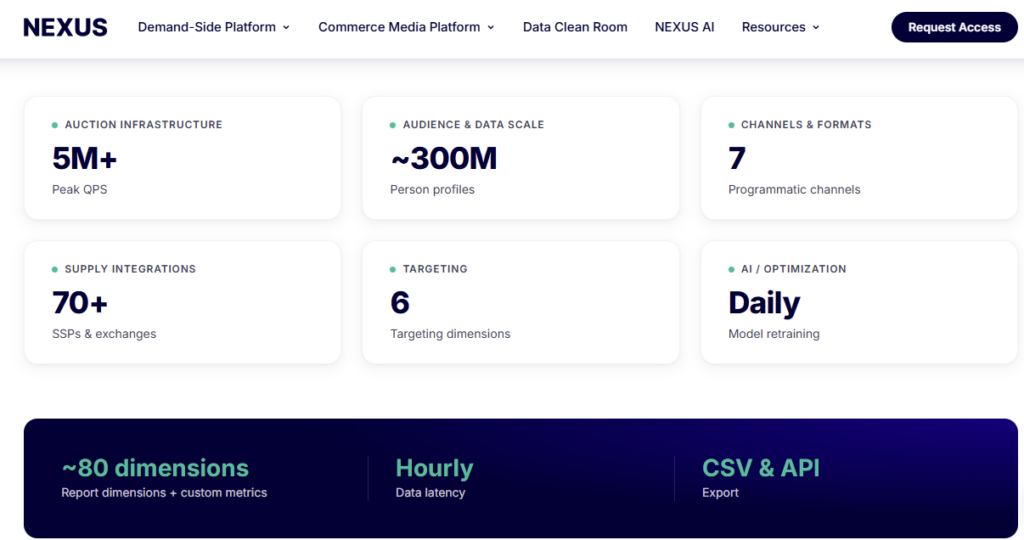
- The Demand-Side Platform connects to more than 70 SSP and ad exchange integrations, with additional direct publisher connections through OpenRTB.
- The infrastructure handles over 5 million peak queries per second (QPS), with a median bid latency of approximately 100 ms.
- Through its Programmatic Ad Networks, NEXUS provides access to curated vertical networks, direct publisher contracts, and formats such as sponsored content and native-in-network placements. This gives advertisers another way to reach publisher inventory when a curated network is a better fit than buying through broader exchanges.
- Buyers have access to impression-level audit logs and disclosures of the percentage of media fees. NEXUS also supports sellers.json and ads.txt for supply-chain transparency.
Who NEXUS is best for: NEXUS suits big brands and agencies managing substantial advertising budgets.
NEXUS pricing: a minimum deposit of $30,000 and a minimum daily spend of $500.
Ad network vs DSP decisions ultimately depend on the inventory, control, and transparency your campaigns require. NEXUS brings both buying models together on one Advertising OS.
Request Access to the NEXUS platform.
Takeaways
- Ad network vs DSP: choose an ad network when its publisher relationships, audience, or formats meet your campaign requirements.
- Choose a DSP to buy in a centralized way across multiple exchanges, SSPs, and publisher sources.
- Consider overall campaign costs, not just CPMs or platform fees. Know what you are getting for your money.
- When your campaigns require both broad programmatic access and curated network inventory, consider using both buying models.
- NEXUS offers both buying models for large agencies or brands looking for DSP and Programmatic Ad Network capabilities in one Advertising OS.
Frequently asked questions
Not always. A DSP is ideal for campaigns needing multiple supply sources and greater control over bidding and targeting. An ad network can better serve a particular group of publishers or placements. NEXUS combines both buying models on a single Advertising OS.
Yes, an advertiser can run an ad network and a DSP at the same time. Advertisers can use a DSP for broader programmatic buying and an ad network for specific publisher placements or formats. Through its Demand-Side Platform and Programmatic Ad Networks, NEXUS supports both options.
An ad exchange is a marketplace for buying and selling impressions, usually through automated auctions. An ad network collects publisher inventory and sells it to advertisers. NEXUS combines DSP access to exchanges and publisher supply sources with curated Programmatic Ad Networks on one Advertising OS — See how it works.
An ad server manages ad selection, delivery, and tracking. A DSP evaluates advertising opportunities and manages bidding. NEXUS's relevant offerings include its DSP and Programmatic Ad Networks.



Request access to NEXUS
See how this runs on your own data. Request access to get started.
Request Access