How to Launch a Retail Media Network: A Guide for Retailers
On this page
- What Do You Need Before Launching a Retail Media Network?
- How to Launch a Retail Media Network in 5 Steps
- Build vs. Buy: Which Retail Media Network Setup Makes Sense?
- How Much Does It Cost to Launch a Retail Media Network?
- Managed Service vs Self-Service Retail Media
- How Long Does It Take to Launch a Retail Media Network?
- Launch Your Retail Media Network with NEXUS
- Takeaways
- FAQ
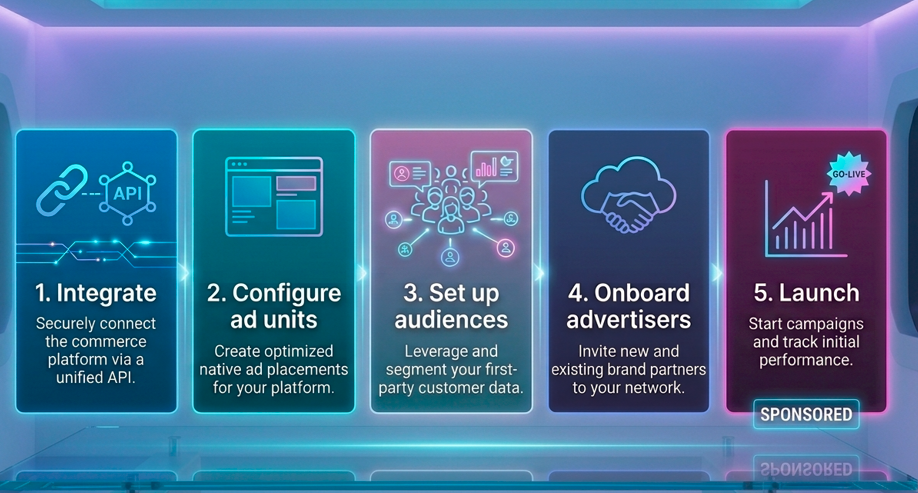
- How to launch a retail media network in 5 steps:
- Integrate your commerce platform and product catalog.
- Configure ad units that fit your inventory.
- Set up first-party audiences and data controls.
- Onboard advertisers with campaign management, billing, and reporting.
- Test and launch, starting with a small group of advertisers.

How to launch a retail media network when you’ve got the audience, the suppliers, the digital inventory, but not the advertising technology to monetize those assets?
Retailers, marketplaces, and commerce platforms face the difficult task of choosing the right retail media network structure to monetize without burdening engineering and operations teams.
In this article, you will learn how to set up a retail media network, covering the five implementation steps, retail media advertising formats, costs, and launch timelines.
What Do You Need Before Launching a Retail Media Network?
First, decide what your network will provide, which advertisers will target your audience, and what work your team will do.
Consider five aspects:
1. Retail media inventory
Begin by discovering the space that you can sell to advertisers.
For online retailers, it can include product search, categories, and product pages, as well as other parts of the shopping experience.
If you run a marketplace, you can provide inventory spaces among seller storefronts. For a delivery service, you can offer advertising within the app.
Inventory shapes ad formats and placement, and affects your retail media network pricing and reporting.
2. First-party data
Understand whether your platform already collects valuable information from customer accounts, product interactions, searches, and transactions. With first-party data, you can segment your audience and deliver relevant ad placements.
Before using this information, you need to clarify what data can be used, how it’s collected, and the permissions or controls around it. Data and legal teams should also be involved.
3. Advertiser demand
It is important to understand what companies will be interested in accessing your audience and inventory.
For a retailer, your existing suppliers and brands may be the main advertisers, while a marketplace may include stakeholders such as sellers who want to increase the visibility of their products.
Speak to potential advertisers prior to the development stage to understand what features will be important for them in retail media marketing.
4. Ownership
Ownership is critical to running any advertising business, including advertiser relationships, campaign setup, inventory management, billing, and technical aspects.
A full-fledged team to handle all of that at once may not be necessary, but their roles must be clearly defined.
5. The revenue model
Make sure you know how the advertisers are going to pay. Possible models include CPM, CPC, and fixed price. The choice will depend on the ad type, measurement, and how advertisers want to buy media.
That’s how you will define the technology you need and the scope of your launch.
See how operators launch retail media on NEXUS.
How to Launch a Retail Media Network in 5 Steps
Once you have identified all your data, inventory, advertiser demand, and internal needs, it is time to start building the network. The next five stages cover all the major decisions associated with this step.
1. Integrate your commerce platform
Integrations with systems that manage products, inventory, and digital assets are critical for your retail media network. The specifics of those integrations depend on the nature of your business and the placement of ads.
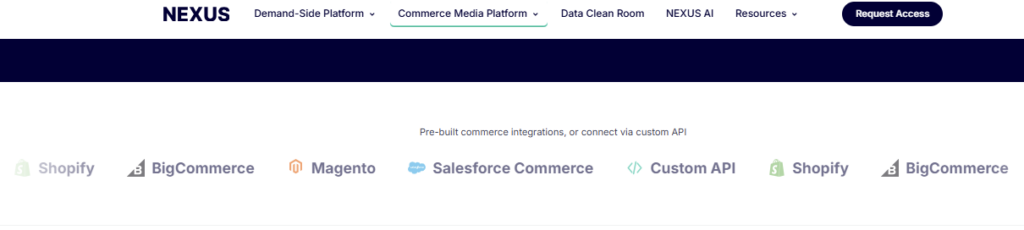
For ecommerce retailers, a commerce platform may be the first system you want to connect to. NEXUS integrates with Shopify, BigCommerce, Magento, Salesforce Commerce, and any other platform via a custom API.
Before integrating your platforms, clarify how product information, identifiers, inventory data, and any signals needed to target customers will flow between systems. Also confirm how advertising placements will be rendered and tracked.
Perform the integration and test the connection before you start accepting advertising campaigns from advertisers. Make sure product information is correct and matches the relevant listings, inventory changes are handled correctly, and advertising activity is traceable through your reports.
2. Configure your ad units
Your ad formats should reflect your available inventory and the user experience customers expect from your platform. You don’t need to implement all possible formats at once.
Start with ad placements that fit existing properties and give advertisers clear reasons to use them.
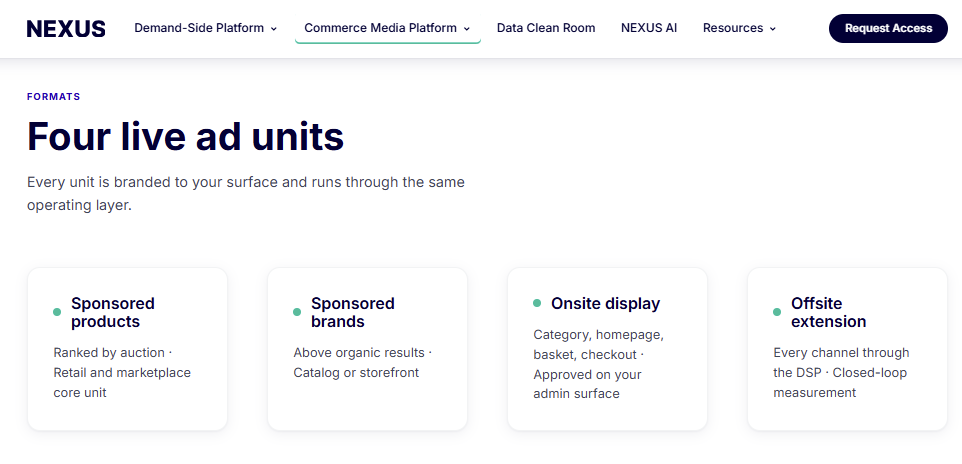
Common retail media ad formats are:
- Sponsored products or listings: Paid placements that highlight the chosen products in the search results, categories, or product listings.
- Sponsored brands: Ad formats that highlight the product range or brand identity.
- Onsite display: Display ads on the website or app.
- Offsite extension: Ad formats that use retail media audiences to reach people outside the platform with DSP integration.
- In-store media: Advertising placements within physical retail environments, where the operator has the necessary screens or other media inventory.
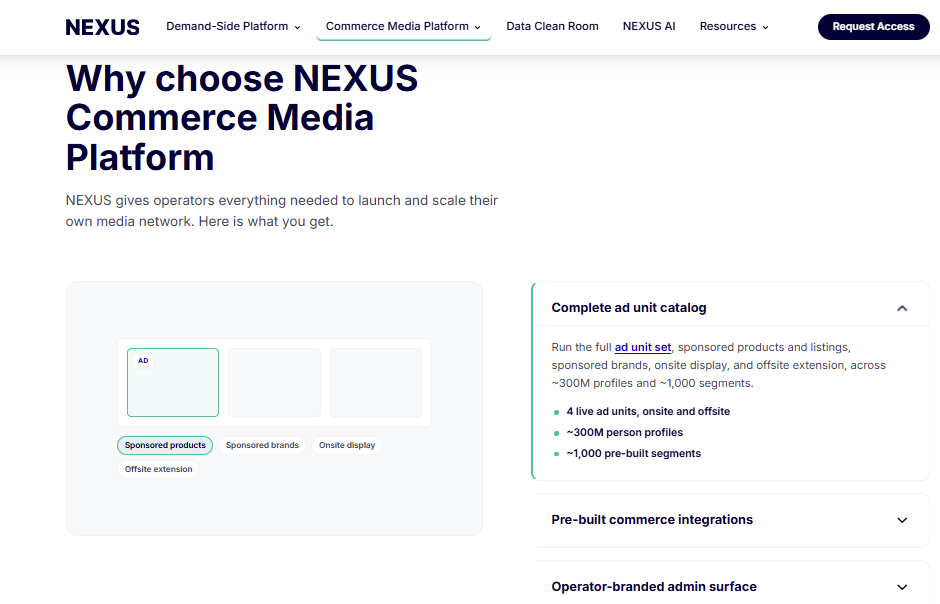
NEXUS supports Sponsored Products and Listings, Sponsored Brands, Onsite Display, In-Store Media, and Offsite Extension. Every unit is branded to your surface and runs through the same operating layer. All you do is switch on the units you want, set pricing, and brand each placement to your surface.
Still, the right format depends on your business. An online marketplace with a big product catalog can start with sponsored listings. An online retailer with high traffic and existing brand relationships may also have demand for onsite display.
Tip: When choosing the platform, ensure it supports the formats you are going to sell.
Also consider offsite advertising, since the campaigns will be served beyond your existing digital properties. Understand how the audiences are activated, what kinds of buying infrastructure are used, and how the results are measured.
3. Set up audiences and data controls
The audience capabilities of your media solution can make your retail media product more valuable for advertisers. Instead of selling media placement, you can offer them opportunities to target audiences based on approved first-party data and other signals.
First, you need to decide what types of data will be utilized and how audience segments will be built. Your legal and data teams should outline the access permissions, retention period, and controls necessary for every use case.
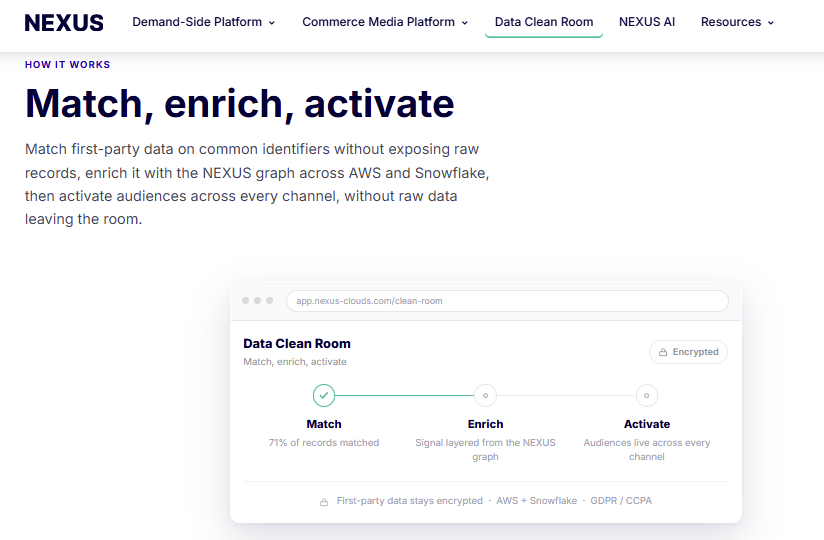
Data Clean Room allows you to cooperate with your advertisers without transferring the raw customer data to them. It provides a way to match, enrich, and activate the allowed data.
New to the term? See our guide on what is a data clean room.
With NEXUS, operators bring their first-party customer data into the platform, where it can be structured into audience segments. Its native Data Clean Room supports data:
- Matching on common identifiers
- Enrichment with the NEXUS graph across AWS and Snowflake
- Activation across every channel, without raw data leaving the room.
Your technical team also needs to analyze identity support, frequency of audience updates, and reporting options for the activated audiences. This is important for advertising campaigns where the advertiser wants to know the audiences targeted.
Note: Audience access does not replace data governance. You need to document the allowed uses of the customer data and ensure that there are the necessary platform controls.
4. Onboard advertisers and configure operations
As a retail media network operator, you need to design a workflow for adding advertisers to your platform and running their campaigns.
You will need to decide who is allowed to register, what validations they need to pass, and how they will set up and pay for their campaigns.
Your operating model should cover:
- Advertiser registration and business validation.
- Account permissions and access levels.
- Campaign creation, approval, and scheduling.
- Budget and billing setup.
- Placement and inventory management.
- Campaign reports and customer support.
It’s up to you to decide on the degree of control over advertisers’ activity. While some operators prefer to manage the campaigns on behalf of suppliers, others prefer the advertisers to operate through a self-service interface.
In both cases, your ad operations team will need insight into the campaigns’ activity. They will have to review placements, track the delivery, solve any issues that might come up, and get access to reporting data without doing everything manually.
NEXUS Commerce Media Platform offers the operator administration of advertisers and campaigns, billing, and brand safety. Advertisers receive access to the self-service dashboard under the operator’s brand.
So, the operator keeps control over the network while advertisers have a place to manage campaigns.
5. Test and launch the network
Before rolling out the network to advertisers, test the entire campaign process.
Seeing a placement on the web page in the right place is one test, but you also need to verify that the settings, targeting, delivery, reporting, and billing work as expected.
A practical retail media network launch 2026 checklist includes:
- Product and inventory data is received properly.
- Sponsored placements show up in the right places.
- Advertisers have the right permissions for their role.
- Budgets and dates are being applied properly to campaigns.
- The appropriate audience segments are being delivered.
- Campaign reporting captures delivery and engagement.
- Billing records align with the campaign activity.
- Brand safety and operational settings are set.
- Support staff knows how to handle campaign issues.
At the start, it makes sense to run some campaigns with a limited number of existing advertisers.
After launch, review delivery, advertiser feedback, placement performance, and revenue, and adjust inventory, pricing, and operational processes based on what you learn.
Launching the network is only the beginning. The network requires ongoing management as advertiser demand, available inventory, and campaign volumes increase.
See how NEXUS runs this on your data
Everything in this article runs on NEXUS today.
Build vs. Buy: Which Retail Media Network Setup Makes Sense?
The technology decision affects your level of control, the length of the implementation process, and the controls your team needs to maintain.
Compare the two approaches for how to launch a retail media network.
Building the technology in-house
Building your own retail media technology gives you control of the product architecture, integrations, campaign workflows, and development priorities.
But this involves more than just building the interface for placing ads. You need the underlying advertising technology, such as campaign management, a retail media ad server, audience activation, reporting, billing, and other functions.
You will also be responsible for platform maintenance, addressing all technical questions, and expanding the capabilities of the network.
This is one of the best programmatic retail media strategies that makes sense if advertising technology is an inherent part of your core capabilities. It is also ideal when you have enough technical resources and budget to invest in this solution long term.
Buy an existing platform
Using an existing retail media platform allows you to build less infrastructure in-house.
Instead of building everything from scratch, your team integrates with existing technology and configures the network according to your business needs.
The drawback is that you need to carefully evaluate the platform’s capabilities, integration options, operating model, and terms. You also need to determine which functions you can configure independently and which rely on the provider.
Providers in this space include Kevel, Topsort, Criteo Commerce Max, and NEXUS.
NEXUS Commerce Media Platform supports operator-branded advertiser dashboards and provides tools for managing advertisers, campaigns, and billing.
How Much Does It Cost to Launch a Retail Media Network?
Many factors determine how much it costs to build a retail media network and whether to develop the technology in-house, license it, or use a white-label platform.
These are the five cost factors to consider when planning how to launch a retail media network :
- Technology: in-house development, platform licensing, and required technology such as infrastructure, ad serving, and more.
- Integration: integration with the commerce systems, product catalog, required data, and finance.
- People: commercial team, account managers, ad ops professionals, engineers, and other support personnel.
- Measurement & verification: reporting, campaign management, ad quality, and third-party verification if needed.
- Ongoing operations: maintenance, technical support, platform updates, advertiser onboarding, and campaign management.
Tip: Avoid judging different retail media advertising platforms by their implementation cost alone. The lower implementation fee may mean higher costs for additional development and operations later.
Make a total cost of ownership assessment covering a minimum of two to three years. Calculate:
- All implementation expenses
- Recurring fees for the platform
- People costs
- Maintenance costs
Then compare this against the revenue you expect to generate from the network.
Managed Service vs Self-Service Retail Media
Your operating model will define how much campaign management work your team will do compared to advertisers doing it. The two primary options are managed service and self-service, although some networks use a blend of both.
Managed service retail media
Managed service means your team takes on most of the campaign activity for advertisers. This includes campaign set-up, placements, budgets, optimizations, and reports.
It gives operators more control over campaign execution and can be useful when advertisers are unfamiliar with retail media.
The downside is that a managed service requires people to do campaign requests and ongoing account work. With more advertisers, the team may need more capacity.
Self-service retail media
Self-service gives advertisers the tools to create and manage their own campaigns.
The operator can set permissions and controls that let them choose placements, set budgets, and review performance through the platform. Your team still has to deal with access management, inventory, billing, and platform performance.
A hybrid model combines the above two approaches: you may want to provide managed service to advertisers in need of your support and let suppliers with experience manage their campaigns.
Verdict: Choose the approach that works best for your advertiser base and staff resources. You can gradually add more self-service functionality as advertisers get used to the network.
How Long Does It Take to Launch a Retail Media Network?
How long it takes to launch your own retail media network depends on the technology you use, the type of integrations, ad formats, data needs, and how ready your internal teams are.
NEXUS assists operators in getting their commerce media operation up and running in under 30 days.
Before setting a launch date, confirm the implementation plan with the technology provider. Check:
- Required integrations
- Who is responsible for each task
- When testing will be conducted
- The conditions that must be met before the network goes live
Another strategy is to launch with a small scale of placements and advertisers. This will give your team a chance to test the operation first before rolling it out fully.
Launch Your Retail Media Network with NEXUS
The first step in learning how to launch a retail media network is choosing the right commerce integrations, ad formats, audience, and advertiser management capabilities.
The NEXUS Commerce Media Platform helps retailers, marketplaces, and commerce platforms like fintech, delivery, and travel companies run their own media network without building everything from scratch.
This includes commerce platform integration, five supported ad formats, Data Clean Room technology, and the advertiser’s dashboard with your brand.
Request Access and launch your network with NEXUS.
Takeaways
- How to launch a retail media network: Integrate, configure Ad Units, create audience segments, onboard advertisers, and launch
- Select your approach from two options: build or buy an existing platform.
- Link your commerce systems, audiences, advertisers, and billing.
- Use NEXUS to build a Commerce Media network in under 30 days.
Frequently asked questions
For most operators, the fastest way to launch a retail media network is to use an existing advertising technology platform rather than build the entire ad stack in-house. NEXUS helps operators launch a commerce media network in under 30 days.
Costs vary widely depending on whether the network is developed in-house or built on an existing platform, as well as integration, staffing, technology, and operations. Compare costs over a two-to-three-year period rather than focusing only on the initial setup fee.
No. The best retail media platforms for brands and commerce operators provide existing advertising infrastructure that businesses can use without developing an entire ad stack in-house. NEXUS offers an operator-branded Commerce Media Platform that lets retailers and commerce businesses launch a network without building the whole stack themselves.
You need advertising inventory, first-party data permissions, potential demand from advertisers and operators and their teams, and pricing models. You also need commerce integrations and technology for campaign delivery, billing, and reporting.
Start with those ad formats that fit with existing inventory and advertiser demand, including Sponsored Products or Listings, Sponsored Brands, and Onsite Display. Offsite Extension and In-store Media are other options available with NEXUS' commerce media infrastructure — See how it works.



Request access to NEXUS
See how this runs on your own data. Request access to get started.
Request Access