13 Best Programmatic Advertising Platforms in 2026
On this page
- The best programmatic advertising platforms split along one line: how much consolidation a single desk gets from one seat.
- NEXUS: An Advertising OS: DSP and ad network for buyers, plus a Commerce Media Platform for operators, all on one infrastructure. 5M+ peak QPS, ~100ms bid latency, 70+ SSP integrations across seven channels.
- The Trade Desk: CTV supply path and supply control solution designed specifically for traders.
- Google DV360: Ideal when YouTube and Google-owned inventory carry the plan.
- Amazon DSP: Retail purchase signal plus Prime Video and Fire TV supply. Best when commerce is the KPI.

The best programmatic advertising platforms should cut the time your team spends moving between tools. If you’re pulling numbers from different tools just to work out what’s performing, you know how quickly the admin adds up.
We’ve compared 13 top programmatic platforms from every programmatic advertisement to help you find one that fits the way your team works.
Programmatic advertising platforms also differ in how they run auctions. If you need the technical side of things first, read up on how programmatic advertising works and the types of programmatic advertising, which explain open auction versus PMP versus guaranteed.
What Separates One Programmatic Advertising Platform From Another
Most lists rank platforms by name recognition. A trading desk needs a better test. These are the points that separate programmatic advertising solutions in practice.
- Auction infrastructure. QPS, bid latency, uptime. A platform that can’t answer bid requests fast enough skips auctions it has access to.
- Supply and SPO. How many SSPs and exchanges, and whether you can collapse duplicate paths to the same impression.
- Seat hierarchy. Sub-accounts under one organization, trader permissions by client, billing that splits per account.
- Inventory and channels. Check which channels you can buy from one place: display, video, native, CTV, DOOH, audio, and in-app. Every extra tool means another login, another set of reports and another bill.
- Audience and identity. Profile pool, prebuilt segments, first-party upload and modeling, clean room, and how many identity solutions carry addressability on cookieless inventory.
- Commerce media. Whether retailer audiences activate from the same seat as open-web demand. Desks reviewing competitors usually decide here, because a split workflow means two logins and manual consolidation every month.
- What you can audit. Fee itemization, audit logs, export schema. Aggregated reporting only, and you can’t reconcile anything.
See where NEXUS fits among programmatic platforms.
13 Best Programmatic Advertising Platforms Compared
The best programmatic ad platforms are not interchangeable; the right choice depends on your channels, team, and reporting needs.
| # | Platform | Clean Room | Standout Features | Best for |
| 1 | NEXUS | Native clean room, supports AWS and Snowflake | 5M+ peak QPS, ~100ms median latency, 99.9% uptime SLA, ~300M profiles, ~1,000 pre-built segments, 70+ SSP integrations, seven channels | Teams wanting an Advertising OS: DSP and ad network for buyers, plus a Commerce Media Platform for operators |
| 2 | The Trade Desk | Limited (UID2, partner passthroughs) | CTV and publisher-direct paths. Configurable bid logic | Enterprise DSP |
| 3 | Google DV360 | Google Ads Data Hub | YouTube and Google-owned supply. | Agencies on Google Marketing Platform |
| 4 | Amazon DSP | Amazon Marketing Cloud | Prime Video and Fire TV placements | Retail and CPG campaigns |
| 5 | Adform | No | ID-based targeting. Built-in ad server | Agencies buying for EU clients |
| 6 | StackAdapt | No | Display, video, CTV, audio, DOOH and native in one interface. | Mid-market DSP / Network |
| 7 | Yahoo DSP | Snowflake integration | Owned inventory alongside open-web supply. | Desks wanting owned-inventory reach |
| 8 | Basis | No | DSP built into a media workflow platform | Desks that want planning and billing in one place |
| 9 | Viant | Google Cloud’s BigQuery integration | Household-level planning and measurement. CTV-led | Household-measured CTV work |
| 10 | Taboola | No | Content recommendation across news and lifestyle publishers. | Content-led traffic and performance |
| 11 | MGID | No | Native and content-recommendation inventory | Scaling native volume with supply-list control |
| 12 | Outbrain | No | Native and content recommendation. | Native and discovery campaigns |
| 13 | Criteo | Criteo Commerce Yield | Commerce media with retailer onsite inventory | Retail and performance budgets |
1. NEXUS: The full-stack option for agencies
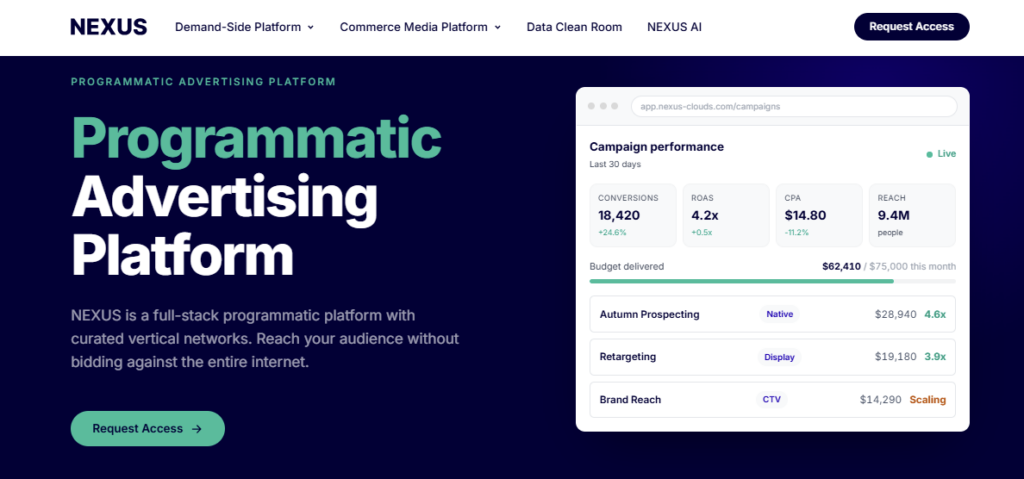
NEXUS is an Advertising OS that brings programmatic buying, supply monetization, and audience activation together on one infrastructure, offering a DSP and ad network for buyers alongside a Commerce Media Platform for operators running their own ad networks. It supports campaign automation across display, native, CTV, DOOH, audio, in-app, and mobile web, with impression-level audit logs and percentage-of-media fee disclosure. This helps teams see what they’re buying and where their spend goes within one dashboard.
- Handle 5M+ QPS at ~100ms decisioning latency under a 99.9% uptime SLA, multi-region
- Buy across 70+ SSP integrations and seven channels covering display, native, CTV, DOOH, audio, in-app and mobile web.
- Build on ~300M profiles with ~1,000 pre-built segments and four identity solutions
- Match first-party data in a native data clean room, not an external environment
- Ads.txt and sellers.json support, plus impression-level audit logs.
Downside: More platform than a single-channel display team may need.
Best for: Teams that want an Advertising OS with a DSP and ad network for buyers, plus a Commerce Media Platform for operators, all on one infrastructure.
2. The Trade Desk: Independent Programmatic Ad Buying Platform

The Trade Desk owns no media and anchors the UID2 standard. If reliability is your main filter, see what’s the most reliable DSP. CTV is a major Trade Desk growth driver, including publisher-direct paths. Traders can configure bid logic and custom algorithms directly.
Downsides: Buying only. Clean room and commerce media rely on partners.
Best for: Enterprise desks with dedicated traders and committed omnichannel budget.
3. Google DV360: Strongest inside Google

DV360 provides access to YouTube and Google’s owned inventory. The programmatic advertising platform lets you purchase YouTube as well as display, video, and CTV from the open web. It reconciles natively with Google Analytics and Campaign Manager 360.
Downsides: Limited supply-path visibility. YouTube’s pricing and reporting differ from the open web, requiring manual normalization.
Best for: Agencies already using Google Marketing Platform tools.
4. Amazon DSP: Commerce signal in a closed loop
Amazon DSP applies Amazon’s shopping and purchase signals to inventory on and off Amazon properties. Prime Video and Fire TV are notable owned placements. You can target using Amazon purchase and browsing signals and tie conversions back to retail sales for endemic brands.
Downsides: Measurement closes inside Amazon. First-party audiences are largely used inside the Amazon ecosystem.
Best for: Retail, CPG, and campaigns with a commerce outcome attached.
5. Adform: Programmatic Platform for EU Buyers

Adform is independent and European-headquartered. Targeting is built around IDs rather than third-party cookies. An ad server is included, which takes a separate serving license out of some stacks.
Downsides: Strongest in Europe, so check US-weighted plans before committing.
Best for: Agencies buying for EU clients with GDPR and fee-disclosure terms in the RFP.
6. StackAdapt: Self-Serve Programmatic Ad Platform
StackAdapt runs display, video, CTV, audio, DOOH, and native from one interface. Native carries a large share of its spend. Managed service is included at mid-market budget levels.
Downsides: Bid logic is less configurable than enterprise DSPs.
Best for: If you are comparing programmatic advertising platforms for small business teams with no in-house trader, StackAdapt’s managed-service model is worth a look.
7. Yahoo DSP: Owned and Open-Web Supply
Yahoo DSP buys its owned-and-operated inventory next to open-web supply. Audiences resolve against a proprietary graph built on logged-in users. Display, native, video, and CTV come from one seat.
Downsides: Identity relies on the Yahoo graph, which limits reach according to the audience.
Best for: Desks that want first-party-backed reach outside a closed measurement environment.
8. Basis: DSP Built Into Media Workflow

Basis incorporates the DSP execution into the workflow for an enterprise digital media platform. The key benefit here is the consolidation of operations. Basis supports buying plus campaign management, billing, and reconciliation.
Downsides: Desks that only need a DSP pay for modules they will not use.
Best for: It is a good fit for desks with a lot of repetitive processes.
9. Viant: Household-Level CTV Buying
Viant plans and measures at the household level rather than device or cookie level. Buying runs through a direct publisher model. CTV is the primary channel, and measurement is people-based.
Downsides: Its channel mix is narrower than omnichannel programmatic marketing platforms.
Best for: Desks running CTV-led brand work for clients who measure on household reach.
10. Taboola: Content Recommendation Platform
Taboola places content recommendation units across news and lifestyle publishers. Launch is self-serve and does not require a trading desk. See Taboola alternatives if native is one line item in a wider plan.
Downsides: It covers one channel, not a stack. Placement quality varies by publisher.
Best for: Content-led performance and traffic, or clients buying direct.
11. MGID: Performance Native Advertising
MGID is often used for performance-focused native campaigns. Its publisher base is weighted toward emerging markets. Check our MGID alternatives that cover the performance-native set in more detail.
Downsides: Offers broad international reach. Supply quality needs active list management.
Best for: Desks scaling native volume on lower CPCs with capacity to manage supply lists.
12. Outbrain: Discovery and native inventory

Outbrain provides native and content recommendation ads on a publisher network that tilts towards news, sports, and lifestyle publishers. The company’s performance solutions optimize for post-click events rather than clicks, and campaigns are self-serve.
Downsides: Single-channel, so it cannot carry a full plan. Placement quality varies by publisher, which means ongoing exclusion list maintenance.
Best for: Native and discovery campaigns bought as a standalone line item.
13. Criteo: Commerce media and retail onsite inventory
Criteo runs commerce media, with retailer onsite inventory alongside open-web display and native. Its identity graph is built on transaction and browsing data from retail partners. Our Criteo competitors comparison covers the wider commerce media set.
Downsides: Non-commerce channel coverage is narrower than omnichannel DSPs.
Best for: Desks running retail and performance budgets with retailer onsite inventory in the plan.
See how NEXUS runs this on your data
Everything in this article runs on NEXUS today. See the Programmatic Advertising Platform page.
How to Choose the Best Programmatic Advertising Platform
The programmatic advertising companies above cover the market. Here’s the shorter route, sorted by what your desk actually looks like.
Desks with five or more traders
You want algorithmic control and full log access. Push vendors on custom bidding depth and impression-level supply visibility, and ask what happens when you need a bid rule that isn’t in the UI. NEXUS runs 5M+ peak QPS at ~100ms median bid latency on a 99.9% uptime SLA.
Agencies consolidating vendors
Count your contracts, reporting layers, and reconciliations before considering any demos. All of this can be consolidated into a single advertising OS, and that alone can have more value. NEXUS runs your DSP, ad network, and commerce media through a single technology platform in seven channels.
Teams considering white-label or reseller options
Test seat hierarchy first, before anything else gets demoed. Independent billing, branding, and permissioning at every level is pass or fail. If a platform can’t handle all three, it will inevitably break down.
Desks with smaller accounts and budgets
Entry minimums rule out more programmatic ad buying platforms than feature gaps do, so confirm the floor early. Prioritize prebuilt segments, so your team isn’t wasting unbillable hours on custom audience builds. NEXUS ships roughly 1,000 prebuilt segments across ~300M profiles.
CTV-Led programmatic plans
Inventory claims all sound alike, so decide on measurement methodology and cross-channel frequency control instead. If CTV sits on a separate seat from display and video, your frequency numbers are an estimate.
Commerce-weighted budgets
You want retailer onsite inventory native to the platform, not bolted on through a partnership that shows up as a second line in reporting. NEXUS commerce media serves operators who run their own commerce media.
Verify the fee model
Ask for the fee structure in writing and ask whether you can reconstruct a month line by line. A low platform fee on top of undisclosed supply markups costs more than a disclosed rate, and the platforms you can’t reconcile are the ones you’ll be replacing sooner.
For channel-level detail, see types of programmatic advertising.
But if your main goal is app growth or conversion performance, this list of Moloco competitors is a good starting point.
The best programmatic advertising platforms match your channels, team size, and reporting needs.
Request Access and compare NEXUS yourself.
Takeaways
- Auction infrastructure sets your ceiling, and NEXUS puts numbers behind it: 5M+ QPS, ~100ms bid latency, 99.9% uptime SLA.
- Integration counts mean little without path visibility, so ask about ads.txt and sellers.json handling, plus SPO controls your team can operate.
- Fee disclosure and audit logs decide renewals more often than optimization features do.
- Full-stack wins when you're paying for reconciliation across multiple vendors. NEXUS provides an Advertising OS with a DSP and ad network for buyers, plus a Commerce Media Platform for operators on one infrastructure.
- Native networks work best as a supporting line item inside a wider plan. Buy them inside a plan, and treat that as a supporting tactic that sits alongside your main plan.
- Identity work can't wait another planning cycle. Four identity solutions and a native clean room give NEXUS a route through signal loss without another vendor contract.
Frequently asked questions
Self-serve platforms with managed service suit beginners, since they don’t require a trader to operate bid logic. NEXUS fits teams that want fee disclosure and ~80 report dimensions from the first campaign — See the platform.
A DSP covers demand-side buying, while the wider programmatic platform category also includes ad networks, commerce media platforms, and operations tools. NEXUS unites buying tools (DSP and ad network) and operator tools (Commerce Media Platform) on a single Advertising OS layer — See how it works.
Most platforms take a percentage of your spend. Data and supply markups sit on top of that, billed separately. NEXUS has a percentage-of-media fee disclosure, and reports spend across 70+ SSP integrations.
Small businesses can use programmatic platforms too; the two key factors to consider are audience configuration and fee transparency. NEXUS includes ~1,000 pre-built segments and geo, behavioral, and contextual targeting, so a small business can get started quickly without configuring new audiences.
The Trade Desk and Amazon DSP both carry large CTV inventory pools and handle CTV-only budgets well. NEXUS runs CTV on the same seat as display and video across all seven channels.



Request access to NEXUS
See how this runs on your own data. Request access to get started.
Request Access