Problems With Programmatic Advertising: 8 Risks to Avoid
On this page
- Bots and low-quality sites are problems with programmatic advertising that can drain campaign budgets
- Some paid impressions never get a fair chance to be seen
- Hidden fees make it harder to know where the money goes
- Buyers need to check inventory, supply costs, and campaign results regularly
- NEXUS brings ad verification, inventory controls, and reporting into one platform

Problems with programmatic advertising often start long before a campaign misses its targets. For most agency teams, it delivered the scale, then quietly taxed the precision.
If your dashboards show clean delivery and pacing but the client’s P&L underperforms, the problem is rarely the media plan — it sits in the underlying ad tech infrastructure executing it.
The 8 problems with programmatic advertising below are the ones our traders often encounter most in account audits. For each, you will find what actually causes the waste and the specific control we advise putting in place.
If you are new to the mechanics, start with our glossary entry on programmatic advertisement and then work through this list against your own account.
Diagnosing Problems With Programmatic Advertising
Most teams know something is wrong before they know what it is. Use this to narrow it down before you change a single setting.
| What you are seeing | Most likely cause | Where to look first |
| Impressions strong, conversions flat | Invalid traffic or bot activity | In-app and long-tail domain reports |
| CPMs cheap, performance looks great, revenue does not move | MFA inventory | Ad-to-content ratio on top domains |
| Effective CPMs rising with no media change | Over-blocking pushing delivery into weak supply | Keyword and blocklist audit |
| Platform totals do not match client totals | Attribution and identity gaps | Deduplication logic across channels |
| Working media lower than agreed | Intermediary fees and resold paths | Fee disclosure and supply path report |
| Viewability below benchmark in one channel only | Channel-specific placement quality | Below the fold and refresh placements |
| Spend concentrated in a few odd segments | Unconstrained automated bidding | Optimization goal and frequency caps |
| High impressions but few measurable conversions across devices | Fragmented identity and attribution | Cross-device reporting and conversion deduplication |
See how NEXUS addresses these problems
8 Problems with Programmatic Advertising
Here are eight issues you should watch for and the controls that can help address them.
1. Ad fraud and invalid traffic still eat the budget
Programmatic advertising ad fraud is no longer just about fake clicks.
Buyers now have to contend with invalid traffic that can imitate ordinary user activity, making it harder to distinguish legitimate engagement from manipulated impressions:
- Data center proxies
- Bots that mimic human scrolling
- SDK spoofing
- Device ID resets, and
- App inventory that misrepresents itself as premium
In 2024, approximately $1.5B of programmatic mobile app ad spend and $1.4B of programmatic CTV was lost due to IVT and ad fraud. This is also one of the challenges of programmatic advertising that some users complain about on Reddit.

Many buyers apply desktop-era IVT settings to mobile supply and assume the protection carries across. It does not.
What we advise: never rely on one layer. Pre-bid filtering stops the impression from being bought. Post-bid reconciliation proves what slipped through and recovers the money. You need both.
How NEXUS addresses this:
- NEXUS combines IAS + DoubleVerify pre-bid + post-bid refund. Pre-bid filtering prevents identified invalid impressions from entering the auction. Post-bid reconciliation deals with impressions that have already been purchased.
- For mobile inventory, NEXUS adds targeted in-app IVT detection to safeguard spend across app and web channels.
2. Spend sunk into made-for-advertising (MFA) sites
MFA sites are the most under-discussed of all programmatic advertising disadvantages. They’re technically:
- real pages
- real impressions
- occasionally real humans
But they exist to arbitrage ad dollars, not to host content anyone chose to read.
Because MFA passes most viewability and IVT checks, it survives the standard quality stack. It shows up as cheap, high-performing inventory — which is exactly why algorithms love it.
In fact, 2023 ANA data show that MFA sites capture 21% of all impressions and 15% of total ad spend.
What we advise: Align your MFA exclusion rules with relevant ANA and IAB guidance. Review domain-level inventory reports regularly instead of relying on a static blocklist.
How NEXUS solves this:
- NEXUS includes settings-based MFA exclusion rules built to ANA and IAB standards.
- Media buyers switch on these parameters when setting up campaigns to keep bids on legitimate publisher inventory.
3. Low viewability wastes ad spend
An ad can count as an impression even if it never gets a chance to be seen.
Ads that are placed below the fold in tabs that aren’t active or in low-quality app spots can boost delivery numbers, but they don’t actually reach users.
The result is a campaign that meets its impression targets but delivers fewer meaningful opportunities to reach its audience.
What we advise: compare viewability across channels and individual placements. If one app, domain, or placement consistently underperforms, investigate its inventory quality before moving more budget into it.
How NEXUS solves this:
- NEXUS integrates IAS and DoubleVerify verification to help buyers assess viewability and inventory quality.
4. Brand safety and keyword over-blocking
Managing programmatic advertising brand safety usually turns into an ugly operational tradeoff. Run ads next to unsafe content, and you damage brand equity. Turn on broad keyword blocklists, and you choke off scale and inflate CPMs.
A data science study shows over-blocking causes brands to incorrectly flag up to 57% of safe news stories, wasting up to 40% of potential reach.
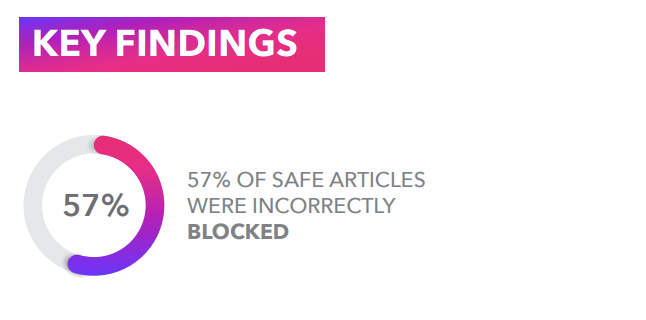
Statistics from CHEQ’s Department of Data Science. Source
This may push delivery into cheaper, lower-quality supply and inflate effective CPMs.
What we advise: Use content-category exclusions to establish broad suitability requirements, then apply custom keyword and domain rules to address specific risks. Review blocklists against actual delivery reports to identify exclusions that are unnecessarily restricting inventory. Maintain allowlists for publishers that meet the account’s requirements.
What NEXUS supports:
- NEXUS provides content-category exclusions, custom keyword and domain blocking, and centralized allowlist and blocklist controls.
5. Supply chain opacity and undisclosed fees
A campaign can hit its delivery targets and still leave an agency with less working media than expected. One reason is the number of intermediaries involved in getting an impression from a publisher to an advertiser.
Between advertiser and publisher sit DSPs, SSPs, exchanges, resellers, data vendors, and verification layers—each taking a cut. Still, other costs cannot be attributed.
In fact, ISBA supply chain research found that 15% of advertiser spend could not be attributed to identifiable costs
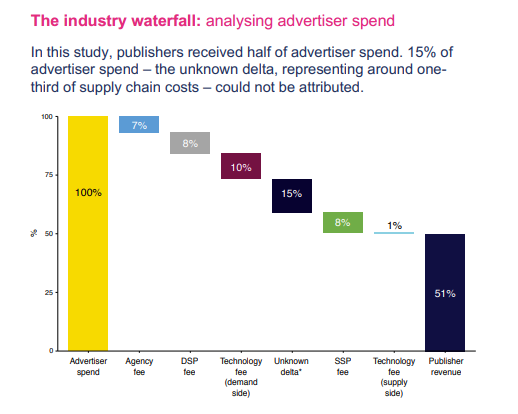
Statistics from ISBA. Source
However, programmatic advertising transparency issues are not only about fees. They are also about:
- Not being able to prove where an impression came from
- How many hops it took, or
- Whether you bought the same impression twice through different paths
What we advise:
- Run Supply Path Optimization (SPO) inside your DSP
- Demand exact percentage-of-media fee disclosures and
- Export log-level data to review execution costs across every vendor in the chain
How NEXUS solves this:
- NEXUS provides clear execution pricing using percentage-of-media fee disclosures.
6. Fragmented attribution and signal loss
A customer could see an ad on their phone. Then take action later on a laptop. If the reporting setup can’t link those moments together, the campaign only gets credit for part of the journey.
Incomplete cross-device measurement can make you undervalue a channel or move budget based on incomplete conversion data, especially as third-party cookies deprecate and privacy regulations tighten.
What we advise: Combine campaign tracking into a single reporting setup. Move past single-touch attribution models and isolated channel metrics to use cross-device identity resolution.
How NEXUS solves this:
- NEXUS combines campaign analytics into one reporting layer. Four identity solutions (NEXUS Native ID, UID2, ID5, and one more industry-standard solution) link user activity across devices, and a native Data Clean Room enables privacy-safe matching of first-party data for more complete attribution.

7. Auction overpayment and suboptimal bidding
Following the industry transition to first-price auctions, bid shading algorithms were introduced to prevent buyers from overpaying.
However, basic bid-shading tools fail to calculate changing publisher floor prices in real time, causing overbid clearing prices or lost bids on valuable impressions.
What we advise: Use real-time bidding engines that evaluate floor prices and dynamic value at the impression level. Adjust bidding parameters automatically using historical clearing data to protect campaign margins.
How NEXUS solves this:
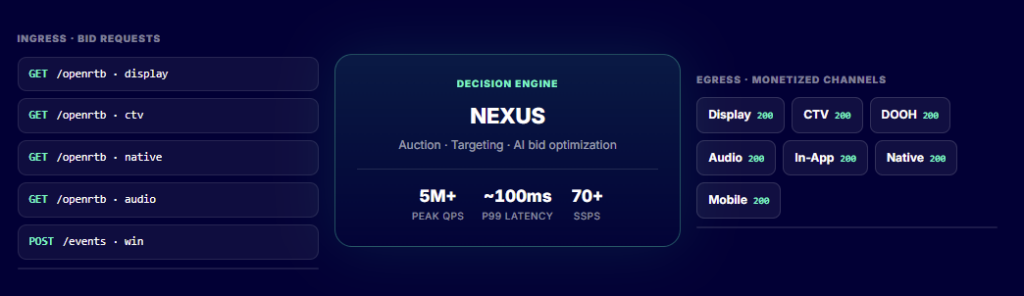
- NEXUS Bid Optimization is a machine learning model that adjusts bids in real time based on impression-level value, helping buyers avoid overpaying while staying competitive on valuable impressions.
8. Algorithmic over-reliance and thin human oversight
Automated bidding is only as good as its constraints.
Unconstrained optimizers find the cheapest conversions available. That usually means harvesting demand that would have converted anyway, often on MFA supply, while the CPA chart looks excellent.
The common programmatic ad mistakes here are predictable:
- Letting bidding run unconstrained for weeks
- Audience segments so narrow they force high CPMs; frequency caps set at launch and never revisited
- An optimization goal that does not match the brief
What we advise: Set supply allow-lists, frequency ceilings, inventory-quality floors, plus a weekly human review of where delivery actually landed.
How NEXUS solves this:
- NEXUS lets buyers set frequency caps, supply allowlists, and inventory controls at the campaign level, while impression-level audit logs show exactly where delivery landed, making the weekly human review straightforward.
Explore how AI in programmatic advertising performs when it’s constrained properly, and compare your options among the best programmatic advertising platforms.
See how NEXUS runs this on your data
Everything in this article runs on NEXUS today. See the Programmatic Advertising Platform page.
Where Problems With Programmatic Advertising Leave Agency Teams
The problems with programmatic advertising are not arguments against programmatic. They’re arguments against unexamined programmatic. Fraud, MFA, suitability, opacity, viewability, attribution, and algorithmic drift are all solvable. But only on infrastructure that lets you see them.
That visibility is the core design principle of the NEXUS Programmatic Advertising Platform: verification at pre-bid and post-bid, settings-based MFA exclusion, disclosed fees, SPO, impression-level logs, and one cross-device reporting layer.
Request Access to the NEXUS platform.
Takeaways
- Check where ads appear, not just how many impressions they get
- Review IVT and viewability by placement
- Watch for MFA sites and unsuitable content
- Check fees across the supply chain
- Do not leave every bidding decision to automation
Frequently asked questions
The main disadvantages include ad fraud, poor viewability, brand safety risks, hidden supply chain fees, and difficulty measuring conversions across devices. NEXUS helps agencies address these issues through IVT verification, inventory controls, supply path optimization, and unified reporting.
There is no fixed percentage of wasted programmatic ad spend because losses depend on traffic quality, inventory selection, intermediary fees, and campaign management. NEXUS provides impression-level audit logs and fee disclosure to help agencies identify where their advertising budgets are going.
Advertisers can reduce ad fraud by filtering invalid traffic before bidding and monitoring impressions after delivery. NEXUS integrates IAS and DoubleVerify for verification, with additional in-app IVT controls and post-bid refund support.
Programmatic advertising can be safe for brands when campaigns use appropriate content exclusions, keyword blocking, domain blocklists, and independent verification — See how NEXUS supports these controls.
Common programmatic advertising problems include chasing low CPMs, overlooking MFA websites, using broad blocklists, and ignoring supply chain fees. Another is relying on impression numbers without checking viewability or invalid traffic.



Request access to NEXUS
See how this runs on your own data. Request access to get started.
Request Access