Programmatic CTV Advertising: How It Works and How to Buy
On this page
- What Is Programmatic CTV Advertising?
- How Does CTV Advertising Work?
- How to Buy Programmatic CTV Advertising
- When to Use Programmatic CTV
- CTV Ad Formats and the Inventory Behind Them
- Programmatic CTV vs Linear TV
- Programmatic CTV Advertising Benefits
- Programmatic CTV Advertising Cost
- Top 5 Programmatic CTV Advertising Platforms
- Takeaways
- FAQ
- Programmatic CTV advertising is the automated purchase of video ads shown on internet-connected television screens, bought one impression at a time.
- The buy runs through a DSP against CTV SSPs over OpenRTB, using the same bidding mechanics as display.
- Targeting happens at the household level through smart TV identifiers, not through cookies.
- NEXUS runs CTV as one of seven channels from a single seat, with impression-level audit logs, ~300M person profiles, and a native clean room.

Programmatic CTV advertising lets agency media buyers reach streaming audiences without booking TV time. Global CTV ad impressions rose 66% in 2024, giving agencies more inventory to use.
The questions remain: Where should you buy your ads? Which households can you actually reach? How do you make sure your budget is going to the right placements?
In this guide, we explain how to buy programmatic CTV advertising, what inventory options are available, and five platforms worth considering.
What Is Programmatic CTV Advertising?
- From the viewer’s side. Someone is watching a show in a streaming app on their living-room TV. An ad break starts, and the ad that plays was chosen for that household a few milliseconds earlier. It runs full-screen and usually can’t be skipped.
- From the buying side. Programmatic means software auctions and awards the impression in milliseconds. Nothing is pre-booked. Each ad break is a fresh decision.
- The technology side. Connected TV programmatic runs on the same infrastructure as other programmatic channels. A publisher’s SSP sends a bid request, and your DSP evaluates it and bids. The winning creative is served through the IAB VAST video standard. Supply comes from streaming apps, TV manufacturers’ own ad platforms, and ad servers built for long-form video.
CTV sits alongside display, audio, and DOOH as one of the types of programmatic advertising, and buyers run it from one seat as part of omnichannel programmatic advertising.
See how NEXUS runs programmatic CTV.
How Does CTV Advertising Work?
Key steps are involved:
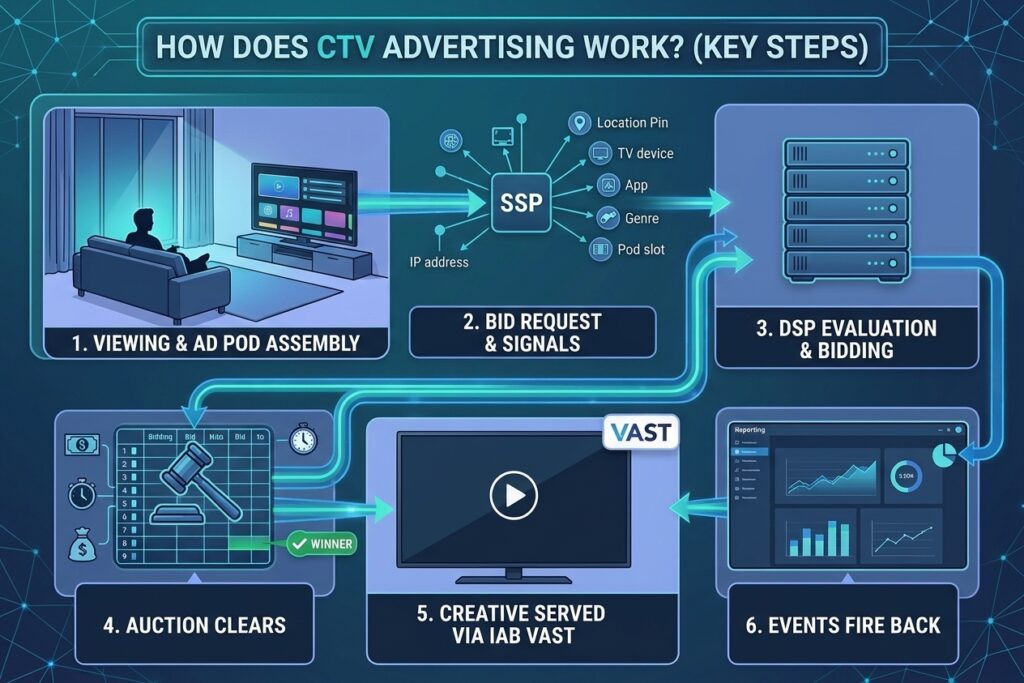
- A viewer opens a streaming app. The publisher’s ad server identifies an upcoming break and assembles a pod — a sequence of slots.
- A bid request goes out. The SSP passes it to connected DSPs with the available signals: IP address, smart-TV or device identifier, app bundle, content genre, geo, pod position, and permitted ad duration. No cookies are involved.
- Your DSP evaluates and bids. The platform matches the request against your audience segments, applies your bid strategy, and returns a price. On NEXUS, that resolves at roughly 100 ms median bid latency, on infrastructure built for 5M+ peak QPS across multiple regions at 99.9% uptime.
- The auction clears. The highest eligible bid wins, subject to competitive separation and your frequency caps.
- The creative is served via IAB VAST. It plays full-screen and sound-on in pre-roll, mid-roll, or post-roll.
- Events fire back. Start, quartiles, completion, and viewability return to the DSP, where they join your reporting layer.
See how NEXUS runs this on your data
Everything in this article runs on NEXUS today. See the Programmatic Advertising Platform page.
How to Buy Programmatic CTV Advertising
Buying programmatic CTV advertising comes down to a few key decisions:
- Define your campaign objectives and target audience
- Choose your CTV inventory and streaming publishers
- Set your budget, bids, and household frequency caps
- Prepare and validate your VAST-compatible creative
- Launch the campaign and monitor performance
When to Use Programmatic CTV
Here are scenarios to use in CTV programmatic advertising:
- Tight geography. Buy a few postcodes instead of paying for national coverage.
- The viewers linear misses. Cord-cutters and light TV viewers who barely register on a linear schedule.
- Retargeting into the living room. A site visit resolves to a household, so a browsing session can follow onto the TV screen.
- Creative testing with real evidence. Run two or three cuts against matched audiences and read completion and lift.
CTV Ad Formats and the Inventory Behind Them
| Format | Where it runs | What it is good for |
| Pre-roll | Before content starts | Higher attention and completion, higher CPM |
| Mid-roll | Inside a pod during content | Volume and frequency at a lower average clear price |
| Post-roll | After content ends | Cheapest inventory; weaker completion |
Note: A rejected asset is the common reason a first CTV flight underdelivers, so submit creative days before launch, not hours.
NEXUS buys CTV supply through FreeWheel, Magnite CTV, Samsung Ads, LG Ads, and Roku, within a wider footprint of 70+ SSP and exchange integrations plus direct publishers over OpenRTB.
Programmatic CTV vs Linear TV
The programmatic CTV vs linear TV decision is rarely either/or: CTV extends reach into cord-cutters and adds the frequency control linear cannot offer. But linear still wins simultaneous mass reach.
| Programmatic CTV | Linear TV | |
| Buying unit | Impression | Spot / GRP |
| Targeting | Six addressable dimensions | Time slots and TV shows |
| Measurement | Impression-level, hourly to next-day | Panel-based, lagged |
| In-flight control | Pause, shift, re-budget | Fixed once booked |
| Scale ceiling | Fragmented across apps and devices | Still the largest single-moment reach |
Programmatic CTV Advertising Benefits
- Addressability on the big screen. Segments, suppression lists, and lookalikes apply to TV inventory.
- Completion as a usable signal. Non-skippable, full-screen delivery produces completion data that in-feed video cannot match.
- One frequency cap across devices. Rather than two uncoordinated schedules.
- Downstream measurement. CTV impression to online conversion, attributed in one reporting layer. On NEXUS, that sits across ~80 reporting dimensions with hourly data latency and CSV or API export.
The honest limit: CTV is not direct response. There is no click. Judge it on incremental reach, completion, and attributed conversions across a defined post-impression window.
Programmatic CTV Advertising Cost
Programmatic CTV CPMs clear above display and below national linear. Price depends on: inventory level, pod placement, geographic location, and targeting.
Advertisers generally pay on a cost-per-thousand-impressions basis (CPM), but there isn’t a single price point for all streaming networks.
Three controls to set before launch:
- Set frequency caps: Prevent excessive household exposure.
- Choose pod positions: Match inventory costs to your campaign objective.
- Check platform fees: Understand the difference between media spend and total campaign cost.
Tip: When you judge CTV cost, look past the CPM. A higher CPM with strong completion rates and measurable conversions can work out cheaper per result than a low-CPM buy that you can’t connect to outcomes.
Top 5 Programmatic CTV Advertising Platforms
We recommend the following as the top CTV programmatic platforms for 2026.
1. NEXUS: Full-stack DSP for omnichannel CTV advertising
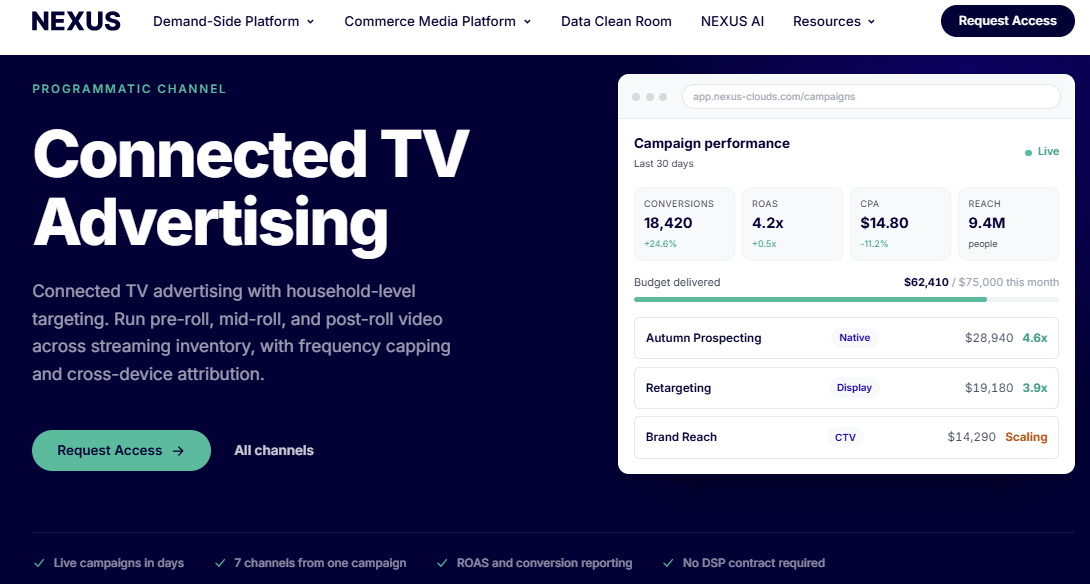
NEXUS is a full-stack DSP where CTV is one of 7 channels — display, native, CTV, DOOH, audio, in-app, and mobile web — bought from one seat.
Key features
- ~300M person profiles, ~1,000 pre-built segments, four identity solutions
- IP and smart-TV identifier matching at the household level
- Native data clean room deployable on AWS or Snowflake
- IAS and DoubleVerify integrated for IVT and brand safety
Best for: the programmatic director who has to show, line by line, what the fee was and which households the budget reached.
2. The Trade Desk: Broad CTV inventory access
The Trade Desk is a DSP that has its own supply channels to CTV ad exchanges, publishers, and streaming apps.
Key features
- Broad independent CTV supply access, including private marketplace depth
- UID2 identity framework adopted across much of the sell side
- Granular bid-factor controls and custom algorithmic bidding
Best for: the senior trader with the headcount to work the bid controls daily.
3. Google Display & Video 360: Across YouTube and Google marketing platforms

Display & Video 360 provides specific CTV buying capabilities and CTV ad inventory from YouTube.
Key features
- Integration with Campaign Manager 360, Google Analytics, and Google Ads data
- Ads Data Hub – privacy-safe log-level analysis of data
Best for: the video planner who needs to reach a goal curve on YouTube.
4. Amazon DSP: Powered by retail purchase data

Amazon DSP offers owned CTV inventory plus retail purchase signals.
Key features
- Amazon Marketing Cloud for log-level queries joining CTV, display advertising programmatic, and sponsored ads
- Prime Video, Fire TV, and Twitch bought directly rather than through a reseller
Best for: retail, CPG, and endemic advertisers that can tie CTV exposure to Amazon purchase outcomes.
5. StackAdapt: Omnichannel CTV advertising
StackAdapt is a mid-market omnichannel DSP known for good workflow and customer support.
Key features
- CTV plus display, native, video, audio, and DOOH
- Contextual and predictive audience tooling
- Self-serve interface built for small teams
- Account support included rather than priced separately
Best for: the account lead running CTV across several mid-size clients.
Verdict: Programmatic CTV advertising gives agencies a way to reach streaming audiences, control household frequency, and measure campaign performance beyond traditional TV metrics.
With NEXUS, they can manage programmatic CTV alongside six other channels, with household-level targeting, transparent reporting, and impression-level audit logs.
Request Access to NEXUS for CTV.
Takeaways
- Programmatic CTV advertising is TV bought on display rails. Same seat, same auction, different screen.
- You're buying households, not people. Your reach number is a count of homes.
- Clicks mean nothing here. Judge it on completion, reach, and attributed conversions.
- Cap frequency before you touch the bid, and read the fee line before you sign.
Frequently asked questions
OTT (over the top) describes any content delivered over the open internet. It covers phones, laptops, tablets, and televisions. CTV is the part of OTT that plays on the TV set. All CTV is OTT. Most OTT is not CTV.
Per impression, no: CTV clears above display and below national linear, so the savings come from reduced waste rather than a lower unit price. NEXUS controls cost with household frequency caps and bidding limited to the segments you actually need — See how it works.
CTV targeting happens at the household level. Each bid request carries a smart TV ID, which NEXUS matches against roughly 300M person profiles before the auction closes, so you can buy on geo, behavior, context, custom lists, lookalikes, or retargeting.
A workable CTV budget is one that delivers three to five impressions per household across your target market within the flight, rather than a fixed dollar floor.
CTV can be targeted by invalid traffic, including spoofed apps and server-side insertion issues, so verification is not optional. NEXUS runs IAS and DoubleVerify on CTV and keeps impression-level audit logs showing the app and device behind every impression — See how it works.



Request access to NEXUS
See how this runs on your own data. Request access to get started.
Request Access