How programmatic advertising actually works in 2026
On this page
- Real-time bidding underpins most open-market ad purchases with an automated path from publisher to SSP to exchange to DSP, all within milliseconds.
- NEXUS gets bid requests from over 70 SSPs and exchanges as well as direct publishers via OpenRTB, with median latency of approximately 100ms and 99.9% uptime.
- During the ad auction, NEXUS enables targeting capabilities based on 6 parameters to process each ad request.

In the world of programmatic advertising, you’re likely familiar with RTB (real-time bidding) and SSPs (supply-side platforms). But how does programmatic advertising work between the moment an ad slot opens and the moment an ad is delivered? That part is harder to understand.
It’s important information, too: eMarketer predicts that programmatic ad spending will account for around 90% of all display ad dollars globally in 2026.
So, how does programmatic advertising work? This guide explains each stage, including who’s involved, the data that passes between them and where key decisions are made.
What is programmatic advertising and how does it work?
To put it simply, programmatic advertising refers to the automated purchase and sale of ad inventory. Different from traditional advertising methods, the software used by both parties determines whether to make a purchase and at what price.
Every programmatic advertisement you see can be attributed to the automated decisions made.
Who’s involved in programmatic advertising
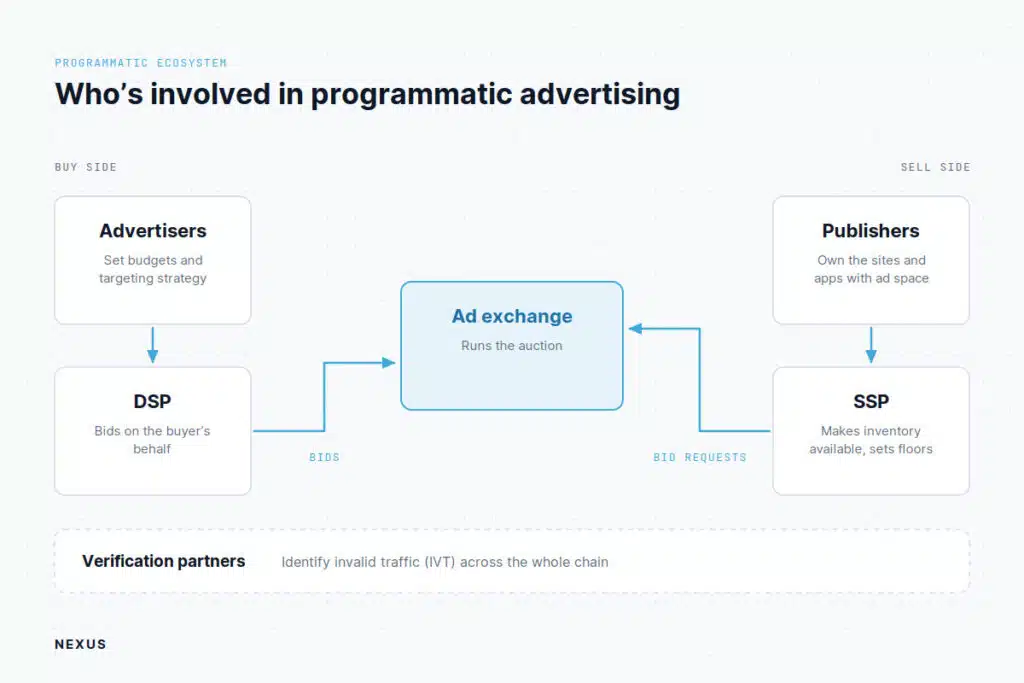
On the buying side of the programmatic advertising ecosystem, advertisers set their budgets and targeting strategies, with demand-side platforms (DSPs) bidding on their behalf.
On the selling side, websites are owned by publishers who make their ad space available through SSPs. Ad exchanges manage the auctions, while verification partners provide services to identify any invalid traffic (also known as IVT).
See how programmatic works inside the NEXUS platform.
The real-time bidding process, step by step
Most open-market purchases are based on real-time bidding technology, which follows the IAB’s OpenRTB protocol.
Here’s a guide to the programmatic advertising process explained from start to finish.
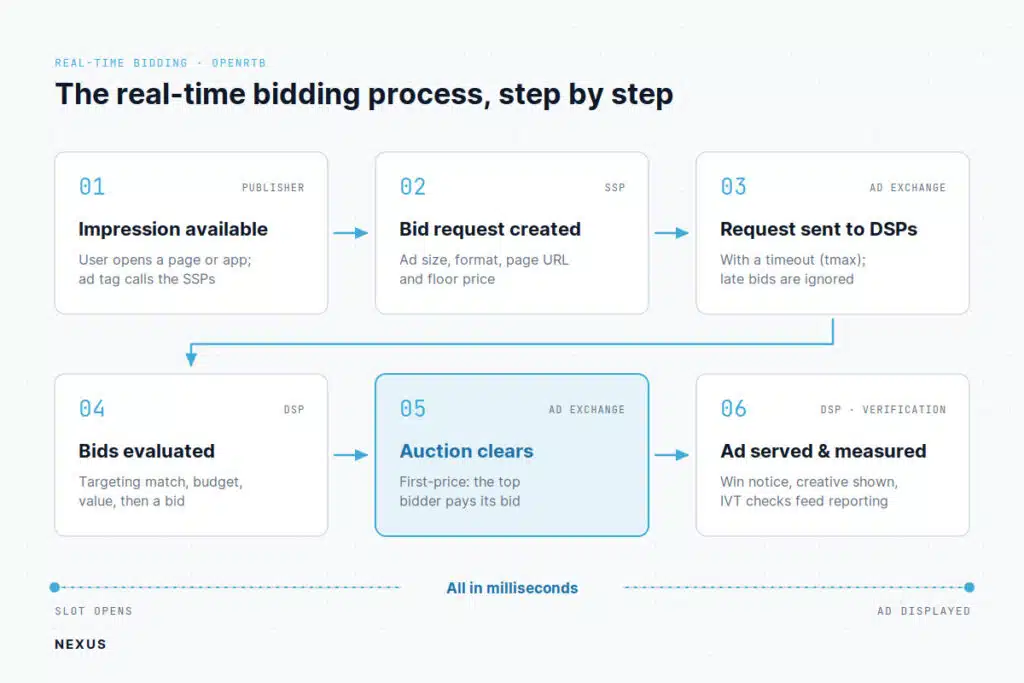
1. An impression becomes available
A user opens a webpage or their favorite mobile app. The publisher’s ad tag (or header-bidding wrapper) requests one or more SSPs to fill an ad space.
2. SSP creates a request for a bid
The SSP creates an OpenRTB bid request based on its existing information including ad size and format, page URL and floor price.
3. The exchange delivers the request to DSPs
The ad exchange forwards the request to connected DSPs with a timeout (referred to as tmax). Bids received after this timeout get ignored.
4. DSPs evaluate and submit bids
Each DSP then checks whether the request matches any active ad campaigns. For example, does it meet the campaign’s targeting criteria? Are there sufficient budget allocations?
If so, the bidder calculates the potential value of the ad impression and submits a bid.
5. The auction clears
The exchange ranks the bids that meet or exceed the floor price, and since most exchanges run first-price auctions, the top bidder pays how much they bid.
With header bidding, the highest bid made by each SSP is then re-auctioned at the publisher’s ad server to choose the ultimate winner.
6. The creative is served and measured
The winning DSP receives a win notice (a notification from the exchange confirming its win), and the creative is delivered to the browser or app; the ad is then displayed.
Following this, verification tools can identify levels of IVT, with the resulting data contributing to reporting and future auctions. The entire process takes a matter of milliseconds to complete.
Private marketplaces and programmatic guaranteed deals are based on the same technology platform with pre-agreed terms; find out more about programmatic advertising options.
Ask a NEXUS expert how the auction and delivery chain works.
See how NEXUS runs this on your data
Everything in this article runs on NEXUS today. See the Programmatic Advertising Platform page.
How does programmatic ad buying work inside NEXUS?
NEXUS is an advertising OS where you can buy media, activate your audiences, and optimize and report on them in one place, rather than spreading data across several platforms.
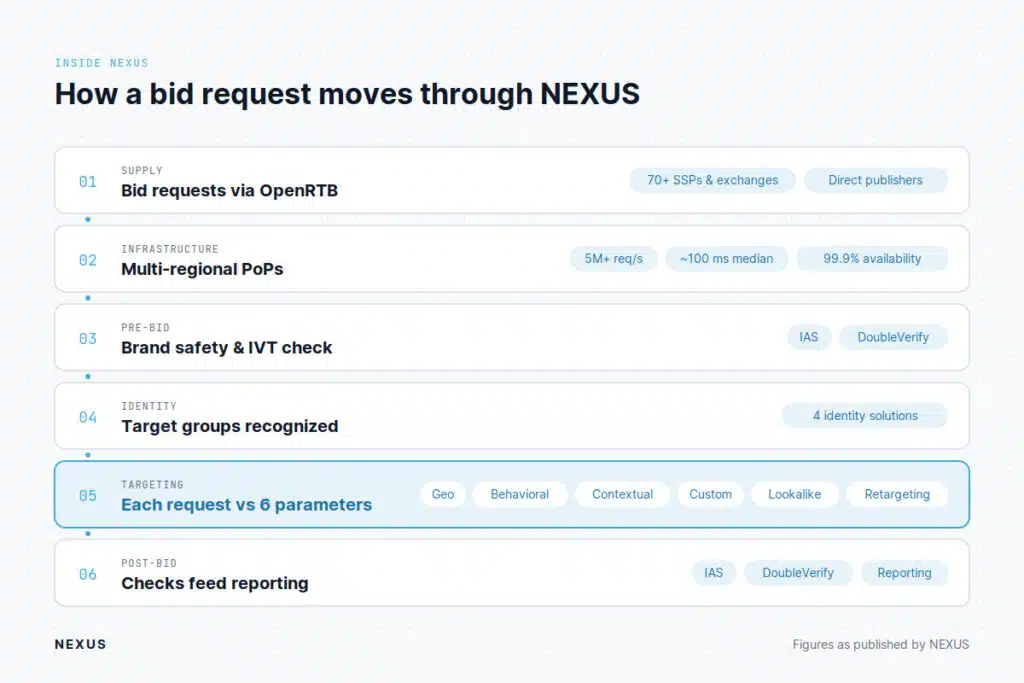
Here are 6 key steps explaining how NEXUS works:
- Bid requests come in from over 70 supply-side platforms and ad exchanges, as well as direct publishers through OpenRTB
- Requests are relayed across NEXUS’s Multi-Regional Points of Presence (PoPs). NEXUS’s bidding infrastructure handles over 5 million requests a second with a response time of ~100 ms median latency and 99.9% availability
- Pre-bidding features provided by IAS and DoubleVerify check for both brand safety and invalid traffic in ad inventory
- User data is processed through 4 identity solutions allowing NEXUS to identify your target groups when receiving a bid request
- Targeting options can be applied during the auction process, evaluating each ad request against 6 parameters: geo, behavioral, contextual, custom, lookalike and retargeting
- After securing an ad placement, IAS and DoubleVerify conduct further brand safety and IVT checks on the ad impression post-bid, with results fed into the reporting platform used to manage your ad campaigns
NEXUS is not the biggest ad tech platform, and it does not claim to be either; it publishes capacity and response times for ad bid requests. Learn more about our programmatic advertising platform.
Tips from NEXUS experts to improve results
Here are the areas where NEXUS experts say you can create successful campaigns.
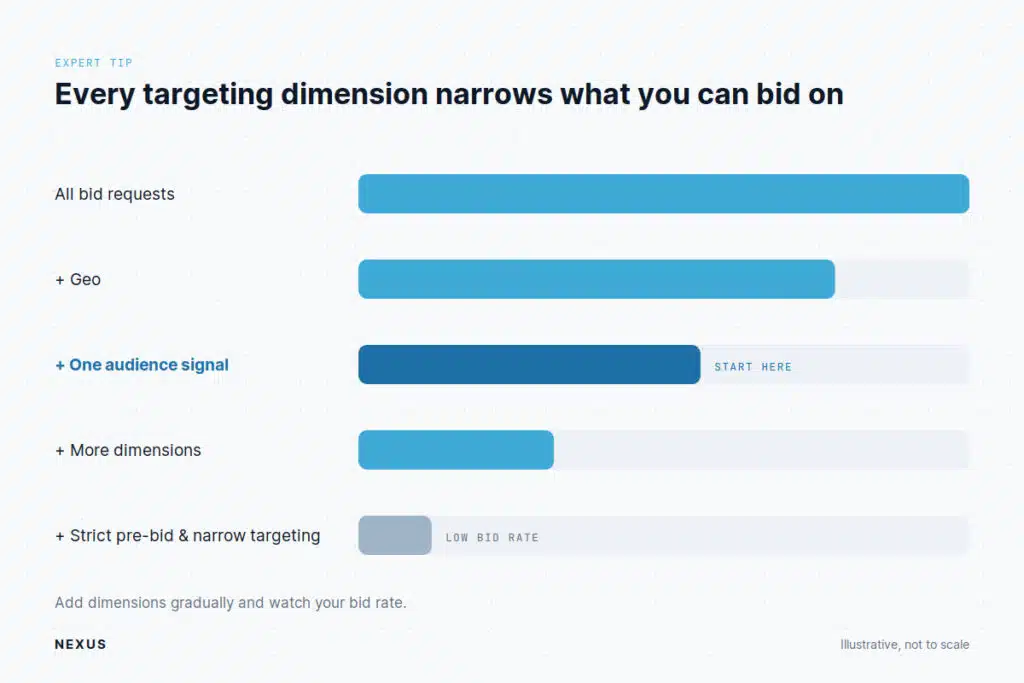
- Keep track of your ad bid rates: If you’re bidding on a limited number of ad requests, it may be because your ad targeting options are too narrow (or your pre-bid settings are too strict).
- Build up your targeting options gradually: Each dimension reduces the number of ad requests you can bid on, so start with location and one other audience signal.
- Create lookalike audiences based on high-quality data: Weak initial data sets lead to poor lookalike audiences; build them from large, effective custom and retargeting lists.
- Remove low-quality ad inventory before bidding: Removing invalid ad inventory pre-bid means that you won’t pay for impressions that post-bid checks would flag.
To find out more about setting up campaigns beyond the auction, read our guides on how to use programmatic advertising and display advertising programmatic buying.
From the mechanics to your first campaign
That’s how programmatic advertising works. Now that you know what each component does, rather than asking “How does programmatic buying work?” you can ask about the settings required to manage different parts of the process and what the numbers represent.
To understand more, see programmatic ad tech in action from within a single platform.
Request Access and see NEXUS from the inside.
Takeaways
- Start with location and one other data point to create audiences, then build additional dimensions over time.
- Check your bid rate. If the number of bids is low, you may be setting your targeting criteria too finely, or your pre-bid settings are too strict.
- You can create lookalike audiences based on large, high-quality custom and retargeting lists.
- Get rid of low-quality ad inventory before bidding, so that you can avoid paying for impressions that post-bid checks would flag.
Frequently asked questions
The SSP sends a request to bid on an ad impression to an ad exchange, which then forwards it to DSPs. Each of the various DSPs determines whether they want to bid and if so, how high. The ad exchange then selects the highest valid ad bid.
The buying side includes advertisers and agencies, while publishers provide the inventory available for sale. Technology platforms, including DSPs, SSPs and ad exchanges enable them to interact. Companies providing data, identity and verification solutions enable you to understand your audiences and ensure the integrity of advertising.
The process from issuing a request to serving the ad itself happens within milliseconds while the webpage is loading. Each exchange has a timeout, and bids received after this are ignored. With NEXUS, the time from receiving a request to bidding is ~100 ms median latency.
The role of the DSP is to act on behalf of the buyer: it identifies available ad space that meets the goals and budget set out in the campaign and places a bid. The SSP acts on behalf of the publisher: it makes available the ad inventory, sets minimum prices and issues bid requests.
No. RTB is one way of purchasing programmatic advertising, with each ad impression going up for auction in a freely available marketplace. Programmatic advertising encompasses automated buying and selling of digital ad inventory.



Request access to NEXUS
See how this runs on your own data. Request access to get started.
Request Access