Top 15 Retail Media Platforms Every Brand Should Know in 2026
On this page
- Choosing between the best retail media platforms for brands starts with one question: are you buying placements, or building a revenue line?
- NEXUS: for retail brands that want to sell ads on their own site and app under their own brand, then keep reaching those shoppers offsite from one account, typically live in under 30 days.
- Skai and Pacvue: for brand teams running budget across several retail networks who need one workflow and one reporting view.
- Amazon, Walmart, Instacart and Roundel: where the largest share of CPG budget goes, and where distribution decides which ones are worth funding.

The best retail media platforms for brands split along one line: some help you sell ads on your own site, others help you buy ads on someone else’s. The tooling looks similar in a demo. The job isn’t remotely the same.
Selling is a revenue line. You own the traffic and the first-party data, and you sell placements to brands that want your shoppers. That means standing up ad serving, yield rules, billing, and advertiser reporting. That’s an operation, not a campaign.
Buying is a media buy. Someone else owns the shelf, you fund a budget, and you optimize across networks you don’t control and can’t see inside of.
Brand-side retail media strategy fails at exactly this point. Most teams at scale end up doing both jobs, and most do both badly, because they picked one tool and asked it to cover them. A working approach separates them on purpose.
In this article, we compare 15 top retail media platforms for brands by what they actually do: sell ads on your own site, reach shoppers off it, or manage spend across networks.
What Retail Media Platforms for Brands Actually Do
Key capabilities separate the best retail media platforms for brands. Most vendors are strong at two or three. New to the vocabulary? Start with our guide to retail media advertising.
- Ad units. Sponsored products, sponsored listings, onsite display, offsite placements.
- Audience data. Purchase and browsing history, grouped into targetable segments.
- Measurement. Whether you can pull enough detail to compare two networks on the same basis.
- Data collaboration. Clean rooms let you match customer files with a retailer without either side handing over raw data.
- Operations. Bid and budget management, pacing, bulk edits, and clean export into your own reporting.
- Cost of entry. Minimum spend commitments, managed-service fees, and whether self-serve access exists at your budget level.
Clean room access and brand lift measurement are native to the NEXUS rather than routed through a third-party partner.
See how NEXUS works for brand-side retail media.
15 Best Retail Media Platforms for Brands Compared
Read this list as a fit map for choosing a retail media platform for brands, not a ranking.
| # | Platform | Sell ads on your own site | Reach shoppers off your site | Clean room | You own the advertiser relationship | Time to live |
| 1 | NEXUS | Yes, white-label | Yes, same account | Native (AWS/Snowflake) | Yes | Under 30 days via Shopify, BigCommerce, Magento, Salesforce Commerce, or API |
| 2 | Kevel | Yes, you build the UI | No, ad serving only | No | Yes | Engineering timeline, you build the UI |
| 3 | Topsort | Yes | Limited | No | Yes | Weeks, marketplace dependent |
| 4 | Criteo Retail Media | Yes, managed | Yes, Criteo demand | Partner-dependent | Shared with Criteo | Network onboarding, contract dependent |
| 5 | CitrusAd | Yes, managed | Yes, Epsilon data | Partner-dependent | Shared | Managed onboarding, contract dependent |
| 6 | Koddi | Yes | Partner-dependent | Partner-dependent | Yes | Implementation dependent |
| 7 | Moloco | Yes, ML-driven | Yes | No | Yes | Integration dependent |
| 8 | Zitcha | Yes | Partner-dependent | No | Yes | Implementation dependent |
| 9 | Pentaleap | Yes | No, onsite focus | No | Yes | Implementation dependent |
| 10 | Amazon Ads | No | Yes, Amazon DSP | Amazon Marketing Cloud | No, Amazon owns it | Account setup only |
| 11 | Walmart Connect | No | Yes, offsite extensions | Walmart Data Ventures | No, Walmart owns it | Account setup only |
| 12 | Instacart Ads | No | Yes, Carrot Ads partners | Limited | No, Instacart owns it | Account setup only |
| 13 | Roundel | No | Yes, Target-owned and partner media | Limited | No, Target owns it | Account setup only |
| 14 | Skai | No | Yes, across networks | No | No, network owns it | Account setup only |
| 15 | Pacvue | No | Yes, across networks | No | No, network owns it | Account setup only |
1. NEXUS: Onsite Ad Units, Offsite Extension and Native Clean Room
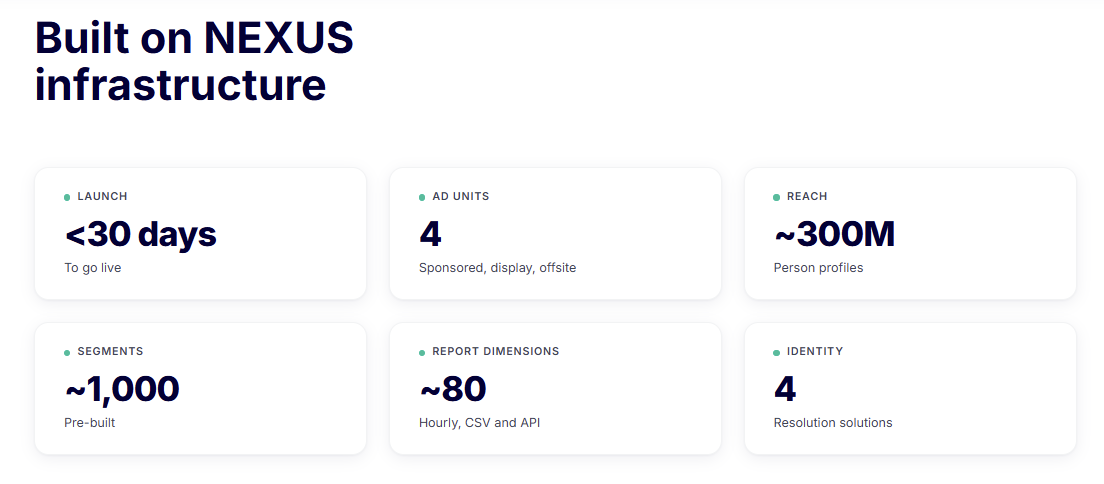
NEXUS is a commerce media platform for operators. You connect your commerce stack, switch on the ad units you want, and onboard advertisers into a dashboard themed as your own. The same shopper audience can then be reached beyond your own surfaces, which is the part most retail media stacks leave you to solve elsewhere.
- Commerce integrations: Shopify, BigCommerce, Magento, Salesforce Commerce, or a custom API.
- Ad units: Sponsored Products, Sponsored Listings, Sponsored Brands, Onsite Display, offsite extension.
- Data collaboration: native data clean room on AWS and Snowflake, with match, enrichment, and activation in one workflow rather than a passthrough to a third party.
- Deployment: operator-branded theming, new operators typically live in under 30 days.
Drawback: in-store retail media is on the roadmap, not shipped.
Best for: retail brands with meaningful owned traffic that want to sell ads on their own site and app under their own brand, and keep reaching those shoppers offsite from the same account.
2. Kevel: Ad Serving Infrastructure for Engineering Teams
Kevel provides ad serving and decisioning infrastructure through public APIs for companies building their own retail media product on top. It supplies the auction, serving, and decision layer, and leaves the advertiser interface, reporting, views, and billing to your engineering team.
Drawbacks: No advertiser demand included, and no native clean room.
Best for: brands whose engineers will build and own the advertiser experience.
3. Topsort: Auction Listings for Multi-Seller Marketplaces
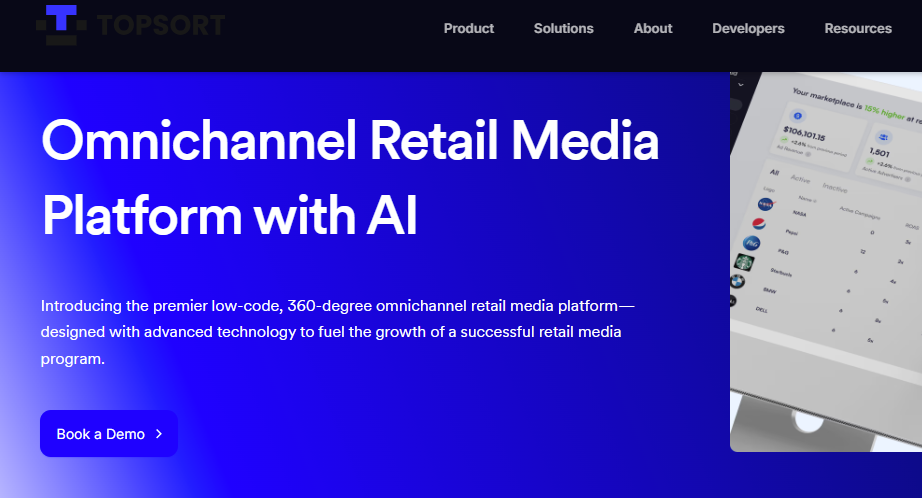
Topsort focuses on auction-based sponsored listings for marketplaces and multi-seller catalogs. Setup leans on self-serve seller onboarding, so sellers fund and manage their own campaigns with limited involvement from your commercial team.
Drawbacks: Offsite reach and data collaboration are limited. No clean room access.
Best for: brands running a marketplace who want sellers funding their own listings without a sales team.
4. Criteo Retail Media: Multi-Retailer Buying in One Interface
Criteo connects brand advertisers to retailer networks through a single interface. It combines the technology retailers use to operate networks with the demand side brands use to buy across them. Managed service is a substantial part of delivery.
Drawbacks: Less operator control of the stack, and clean room capability relies on partners.
Best for: brands buying across many mid-tier retailer networks.
5. CitrusAd: Retailer Networks With Publicis Identity Data
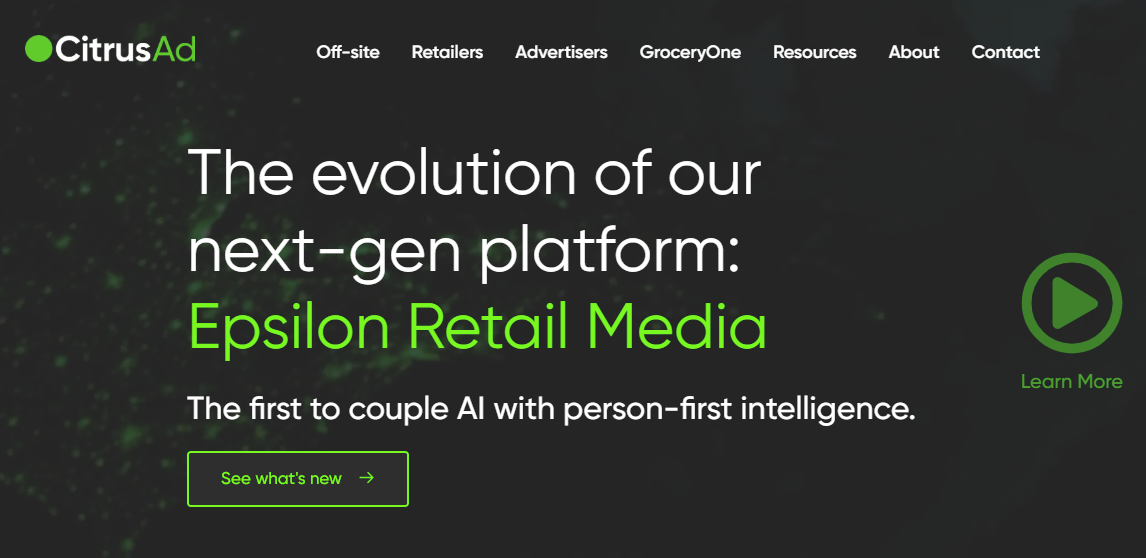
CitrusAd is now part of Publicis, sold alongside Epsilon identity and data assets. Retailers use it for sponsored product and display placements, and brands buy into those networks through it.
Drawbacks: Long enterprise implementation, and value depends on platform commitment.
Best for: brands already inside Publicis and Epsilon.
6. Koddi: Commerce and Travel Media
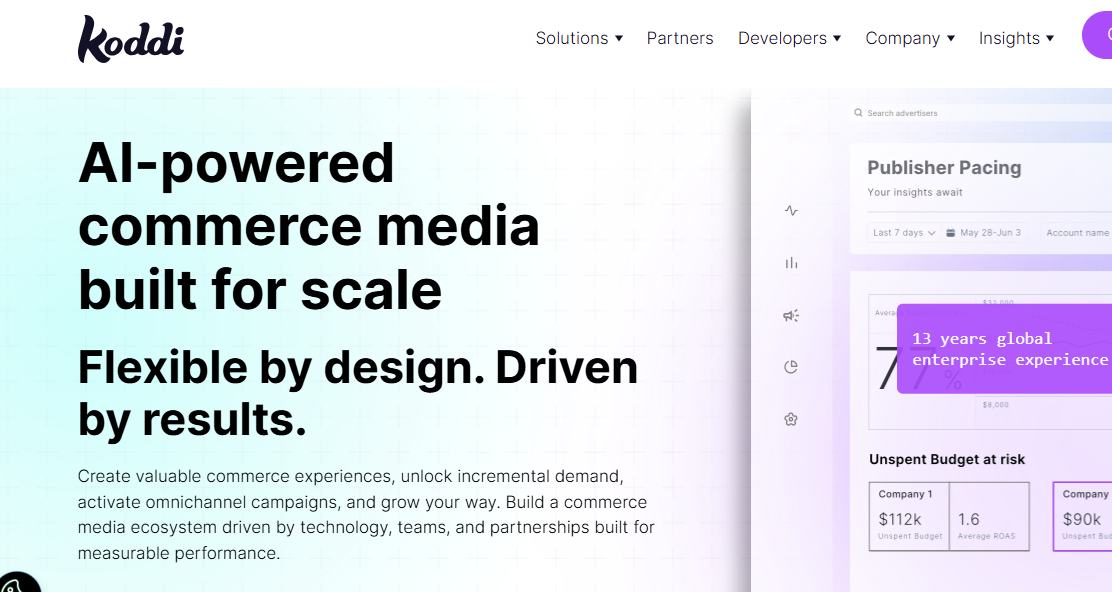
Koddi builds commerce and travel media technology with emphasis on auction control and bidding depth. It covers retail, travel, and marketplace media from one platform, with sponsored listings, display, and reporting for the operator.
Drawbacks: Weaker fit for straightforward grocery or CPG sponsored products.
Best for: travel and large-catalog categories.
7. Moloco: Machine-Learning Ranking for Commerce Inventory
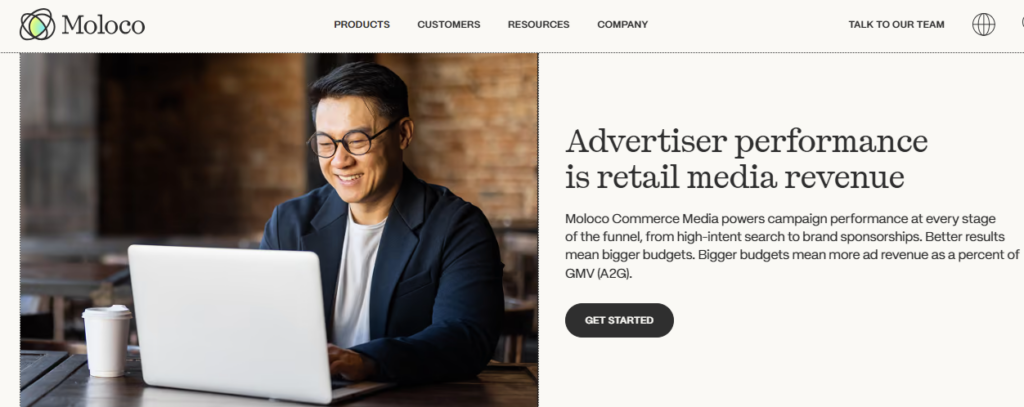
Moloco Commerce Media is built around machine-learning ranking and bidding applied to commerce inventory. It came from mobile app advertising, so it fits environments that generate large volumes of behavioral signals.
Drawback: Needs high transaction volume before the ranking advantage appears.
Best for: brands operating a high-volume commerce app.
8. Zitcha: Supplier Collaboration and Campaign Approval
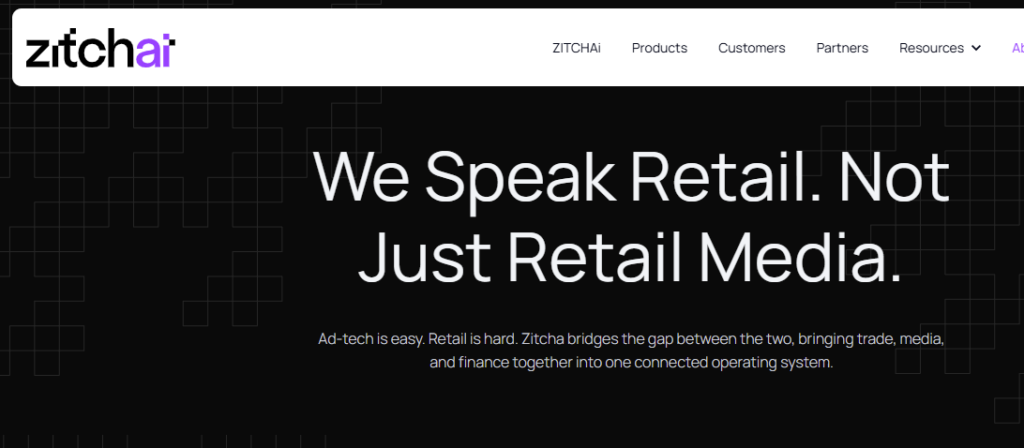
Zitcha sits across a retailer’s onsite inventory and connected offsite channels, with an advertiser-facing portal for planning, booking and reporting. Its focus is the commercial workflow: proposals, approvals, and media plans a supplier-facing team can run.
Drawback: Depends on connected third-party channels for offsite delivery.
Best for: retailers looking for brand collaboration and campaign approval workflow.
9. Pentaleap: Sponsored Search Relevance and Ranking
Pentaleap focuses on retail search and sponsored product ranking, with a decisioning layer that balances ad relevance against organic results. It is designed to improve the quality of placements a retailer already sells rather than to create an ad business from scratch.
Drawback: Limited offsite reach and limited clean room access.
Best for: retailers looking to improve sponsored search relevance.
10. Amazon Ads: Sponsored Placements, DSP and Marketing Cloud
Amazon Ads reaches shoppers at the point of purchase intent. Entry is self-serve. Its Marketing Cloud access requires a DSP relationship, which in practice means an agency or a managed account.
Drawbacks: Closed environment, and audiences do not travel to your other channels.
Best for: brands with Amazon listings.
11. Walmart Connect: Onsite, In-Store and Offsite Extension
Walmart Connect covers onsite search and display, in-store placements, and offsite extension. Display, in-store, and offsite extension run through a Walmart account team and carry spend commitments.
Drawback: Oriented toward large suppliers, so smaller brands get less access and support.
Best for: CPG brands with Walmart distribution.
12. Instacart Ads: Sponsored Grocery Placements and Carrot Ads

Instacart Ads gives food and CPG brands sponsored placements inside a grocery shopping journey. Through Carrot Ads, Instacart also lets other grocery retailers run retail media on its technology.
Drawback: Category-bound to grocery and CPG.
Best for: grocery and CPG brands looking for placements close to basket completion.
13. Roundel: Target Guest Data With Managed Planning
Roundel is Target’s media network, selling onsite placements plus offsite extension against Target’s guest data. Access and planning run through Target’s commercial teams.
Drawbacks: Single-retailer scope, and managed rather than self-serve.
Best for: brands with Target distribution.
14. Skai: Cross-Network Campaign Management and Reporting
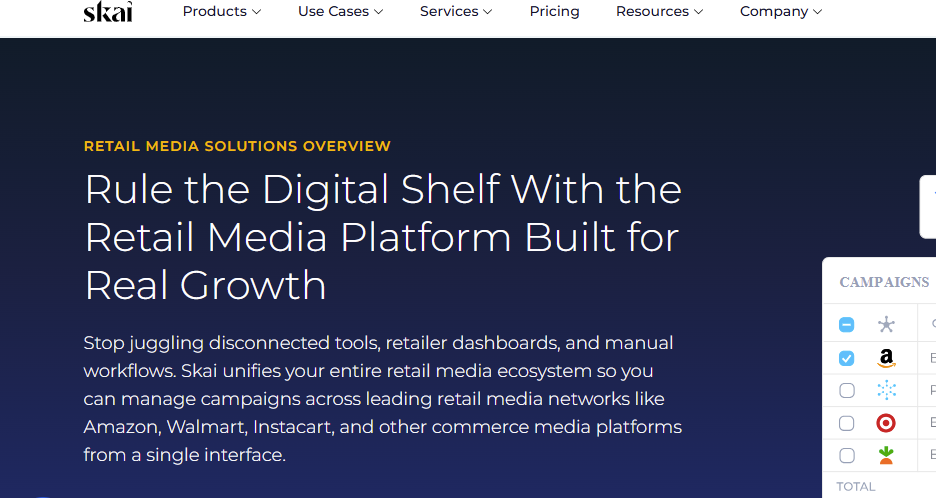
Skai consolidates campaign management and reporting across retail media networks, search, and social. You get one workflow and one reporting view instead of a separate login per network.
Drawbacks: No ad units, inventory, or audience of its own.
Best for: brands running paid media across several retail networks at once.
15. Pacvue: Bid, Budget and Share-of-Shelf Management
Pacvue combines bid and budget management with retail performance data such as share of voice and inventory signals. It is built for day-to-day operating work rather than infrastructure ownership.
Drawback: Execution and analytics layer only, with no owned ad business underneath.
Best for: brand teams managing bids, pacing, and share of shelf across several networks daily.
See how NEXUS runs this on your data
Everything in this article runs on NEXUS today. See the Commerce Media Platform page.
How Brands Choose A Retail Media Platform
Six questions make the retail media platform evaluation criteria worth running a shortlist against.
Are you placing ads or operating a network?
Placing needs inventory quality, targeting depth, and measurement. Operating needs ad units, advertiser onboarding, billing, and theming. NEXUS is built for the operator job and connects it to demand-side reach.
Do your shopper audiences travel offsite?
Ask how offsite works: a DSP integration behaves differently from a reseller arrangement. On NEXUS, offsite extension runs via DSP integration across seven channels and 70+ supply integrations.
Is the clean room native or passthrough?
Native means matching, enriching, and activating in one workflow. Passthrough means a handoff, adding latency, cost, and a second contract. The native NEXUS data clean room is the dividing line against Kevel, Pentaleap, Koddi, and Criteo.
What can you audit?
Check for impression-level audit logs, percentage-of-media fee disclosure, ads.txt and sellers.json. With aggregated reporting only, you cannot reconcile spend.
How granular is the reporting?
Dimensions, latency, and export access decide whether you can reconcile anything. NEXUS reports roughly 80 dimensions at hourly latency with CSV and API export. This is what the best programmatic retail media strategies depend on.
What does it cost to reach viable scale?
Ask for the minimum spend that produces a readable result and whether self-serve access exists at that level. A brand-side retail media strategy that spreads thin across six networks will underperform two networks funded properly.
Retail Media ROI for Brands: How to Measure It
Retail media ROI fails for a mundane reason: the measurement plan is agreed after the spend.
- Set the incrementality question first. Sponsored placements capture demand that already existed, so the honest metric is incremental sales, which needs a clean room test design or a holdout defined before launch.
- Fix the attribution window and hold it. A 14-day and a 30-day window produce two defensible, contradictory ROAS figures for the same campaign.
- Insist on dimension-level export. CSV and API export into your own environment is what lets you compare retail media advertising platforms on one basis instead of accepting each vendor’s dashboard maths.
The best retail media platforms for brands handle the operator job and offsite extension from one account, with a native clean room underneath.
Every quarter you run those as separate systems is a quarter of margin you hand back in fees, and a quarter of shopper data you cannot match. NEXUS was built to close that gap.
Request Access and compare NEXUS yourself.
Takeaways
- Decide the job first. Placing ads and running your own network are different purchases. NEXUS covers both from one account.
- Owned beats rented. Distribution earns budget, owned traffic earns margin. The difference is that only owned traffic builds an audience you don't have to re-buy.
- Offsite reach sets your revenue ceiling. Offsite reach puts you in front of people who shop your category but not your site. NEXUS runs shopper audiences across seven channels via 70+ integrations.
- Granularity wins budget. Clear report dimensions, hourly latency, impression-level logs, and fee disclosure are how you defend spend internally.
- Insist on a native clean room. Kevel and Pentaleap have none; Criteo and Koddi rely on partners, NEXUS runs matching, enrichment, and activation in one workflow on AWS and Snowflake.
Frequently asked questions
Brands should look for ad unit range, targeting depth, measurement granularity, and whether they own the advertiser relationship. NEXUS covers the operator set with roughly 80 report dimensions and impression-level audit logs.
No, concentrate budget on the two to four networks where distribution and margin are strongest. With meaningful owned traffic, a Commerce Media Platform turns that traffic into a revenue line instead of a cost line.
Brands measure retail media ROI with incrementality agreed before launch, a fixed attribution window, and dimension-level data exported into their own environment. The native NEXUS Clean Room lets brand and retailer match files, measure, and activate the resulting audience in one workflow.
Yes. Sponsored listings on one or two high-intent networks outperform thin spend across many, and brands with growing owned traffic can support a small ad business. A new NEXUS operator is typically live in under 30 days — See how it works.
Partly. Skai and Pacvue put buying and reporting for several networks in one dashboard, but each retailer still sets its own ad formats, data access, and measurement rules. NEXUS works the other way: the ad units, shopper audiences, and offsite reach are yours, so there's nothing to reconcile across retailers.



Request access to NEXUS
See how this runs on your own data. Request access to get started.
Request Access