Top Reliable DSPs: 9 Platforms Agencies Trust in 2026
On this page
- The most reliable DSP for advertising agencies combines auction uptime, bid path throughput, fee transparency, and reporting you can hand to a client without rebuilding it.
- NEXUS: The best DSP for agencies that runs a 99.9% uptime SLA, 5M+ peak QPS, and about 100 ms median bid latency.
- The Trade Desk: Independent DSP with access to a wide range of open-internet inventory and strong CTV buying
- Google DV360: Ideal for agencies that use YouTube and other tools within the Google Marketing Platform.
- Amazon DSP: Uses Amazon’s shopping and streaming data to help advertisers find the right audiences on Amazon and third-party inventory.

Choosing the most reliable DSPs for advertising agencies comes down to one harsh reality: when a platform drops bids in peak flights or hides hidden markups, it’s your client’s trust and agency margins that suffer.
Problems like these can undermine client confidence and make it difficult for you to scale. In terms of choosing the right DSP for an advertising agency, it’s not just about the inventory and campaign features. You need solid infrastructure, transparent fees, accurate reporting, and the ability to manage tough auction volumes.
In this guide, we compare 9 top DSP companies against those priorities.
What Makes a DSP Reliable for Advertising Agencies?
When agency programmatic directors look at popular DSPs, they look at core operational metrics. Sales decks are not enough. Any mistakes in auction latency, bid stream throttling, or impression attribution will directly affect client performance and agency profitability.
1. Auction uptime and throughput
An SLA number is only meaningful with a QPS figure next to it. 99.9% uptime on a bidder processing 500K QPS is a different product from 99.9% on 5M+ QPS. Ask for both, in writing, plus the median bid latency.
2. Fee transparency
A common reason for agencies to switch DSPs is learning the effective take rate mid-contract. The question is not “What is your fee? The question is “Is the fee expressed as a percentage of media and can I reconcile it with my log-level data?” Yes to both, and a platform eliminates an argument you’d normally have with your own client.
3. Auditability
Impression-level audit logs, ads.txt and sellers.json enforcement, and domain block list control. This is how you prove to a client that their budget did not fund made-for-advertising inventory.
4. Inventory breadth and supply path
Count SSP and exchange integrations, then ask how many are direct OpenRTB connections to publishers rather than resold hops. For CTV, ask specifically which inventory is direct from the publisher. This is because CTV is where duplicated supply paths cost the most.
5. Targeting and identity
After the cookie, the identity stack matters more than the targeting taxonomy. Ask which IDs are supported and which are modeled natively rather than passed through to a partner. This is because a passthrough integration breaks when the partner match rate drops.
6. Reporting
Dimension count, data latency, export format. An agency needs custom metrics and API export, not a PDF. Also confirm reporting frequency and whether hourly reporting is available.
7. Commercial model and support
Minimum spend, contract length, self-serve against managed service, and whether support is a named team or a ticket queue.
See why agencies run campaigns on the NEXUS DSP.
9 Most Reliable DSPs for Advertising Agencies
Here are the most reliable DSP platforms at a glance:
| # | DSP | Best For | Buying Strengths | Agency Considerations & Trade-Offs |
| 1 | NEXUS DSP | Large agencies and brands, plus independent and mid-sized agencies | 7 channels, 70+ SSPs, 6 targeting dimensions, 4 identity solutions | Overkill for simple, single-channel display or basic ad runs |
| 2 | The Trade Desk | Enterprise Agencies & Trading Desks | Open-internet scale, CTV, UID2 & OpenPath transparency | High spend minimums; requires separate tools for search/social |
| 3 | StackAdapt | Omnichannel Campaign Teams | Fast onboarding, display, video, CTV | Limited enterprise API customization; requires separate non-programmatic tools |
| 4 | Amazon DSP | Retail & E-commerce Agencies | Deterministic shopper data, Prime Video/Twitch, closed-loop sales tracking | Audience value tied to Amazon; clunky interface for non-retail campaigns |
| 5 | Yahoo DSP | Cross-Channel Media Buyers | Proprietary Yahoo 1st-party data, omnichannel CTV, & DOOH reach | Value depends on reliance on Yahoo’s proprietary identity graph |
| 6 | Viant | CTV & Household-Focused Agencies | Household-level graph targeting, cross-device measurement | Less effective for individual-level direct response campaigns |
| 7 | Basis | Full-Service Agencies | Combines DSP buying with search, social, direct media, and billing | Unnecessary SaaS overhead for teams needing only a pure-play DSP |
| 8 | Google DV360 | Google Ecosystem Agencies | Exclusive YouTube inventory, native Google Marketing Platform integration | Bound by Google policies; requires separate platforms for non-Google channels |
| 9 | Criteo | Retail Media & E-commerce Agencies | Direct retail media network inventory, deep SKU-level retargeting | Specialized for lower-funnel retail; ill-suited for general-purpose campaigns |
1. NEXUS DSP: Full-stack advertising platform
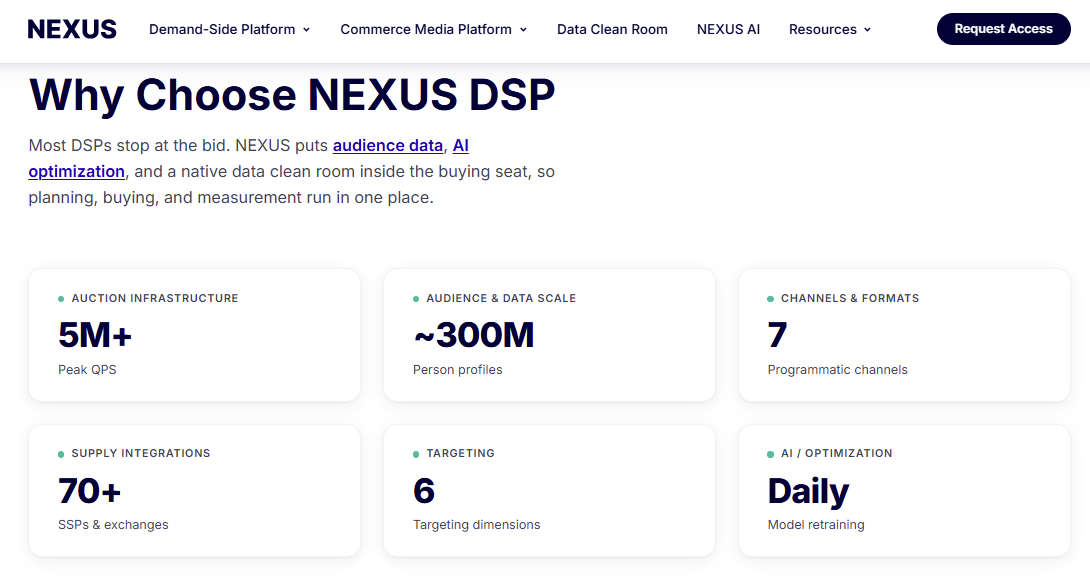
NEXUS is a full-stack Advertising OS that combines programmatic media buying, audience activation, identity solutions, AI optimization, and reporting in one platform. For independent and mid-sized agencies, this provides a way to manage multiple campaign workflows without relying on disconnected buying and reporting tools.
Where NEXUS excels
- Supports 7 channels: display, native, CTV, DOOH, audio, in-app, mobile web.
- Offers 6 targeting dimensions and 4 identity solutions.
- Provides around 80 reporting dimensions, with hourly reporting and API access.
- Supports multi-region infrastructure, a 99.9% uptime SLA, 5M+ peak QPS, and around 100ms median bid latency.
- Fee disclosure and audit logs give agencies better visibility into campaign activity.
Where NEXUS falls short
- If your shop only runs basic search or social campaigns, NEXUS is probably more than you really need.
Who NEXUS is best for
- Large agencies and large brands, as well as independent and mid-sized agencies that want control over media buying and detailed campaign reporting without managing several separate platforms.
2. The Trade Desk: For Enterprise programmatic buying
The Trade Desk provides agencies with access to advertising inventory across the open internet, with tools for audience targeting, campaign optimization, and measurement. CTV is also a major part of its offering.
Where The Trade Desk excels
- Provides agencies access to a broad range of publishers and exchanges on the open internet.
- Its UID2 identity framework and OpenPath initiative support identity and supply-chain transparency.
Where The Trade Desk falls short
- It’s about programmatic buying, not running an agency’s whole media operation.
- Agencies still require other platforms for activities such as paid search, paid social, and direct media buying.
- Smaller agencies may find its operating requirements demanding.
Who The Trade Desk is best for
- Scaled agencies and trading desks with dedicated programmatic teams.
3. StackAdapt: For Omnichannel programmatic advertising
StackAdapt is a self-serve DSP that helps agencies plan, launch, and optimize campaigns across digital channels. It works well for teams that run display ads, native ads, video ads, audio ads, and connected TV ads.
Where StackAdapt excels
- Covers a wide range of digital ad formats.
- Has strong native advertising and content recommendation capabilities.
- Gives agencies campaign planning and measurement tools.
Where StackAdapt falls short
- Agencies looking for a complete system for programmatic, search, social, and direct media buying may need additional tools.
- Its wide range of features may be more than smaller teams need.
Who StackAdapt is best for
- Agencies prioritizing native, CTV, and hands-on support.
4. Amazon DSP: For Commerce and shopping audience advertising
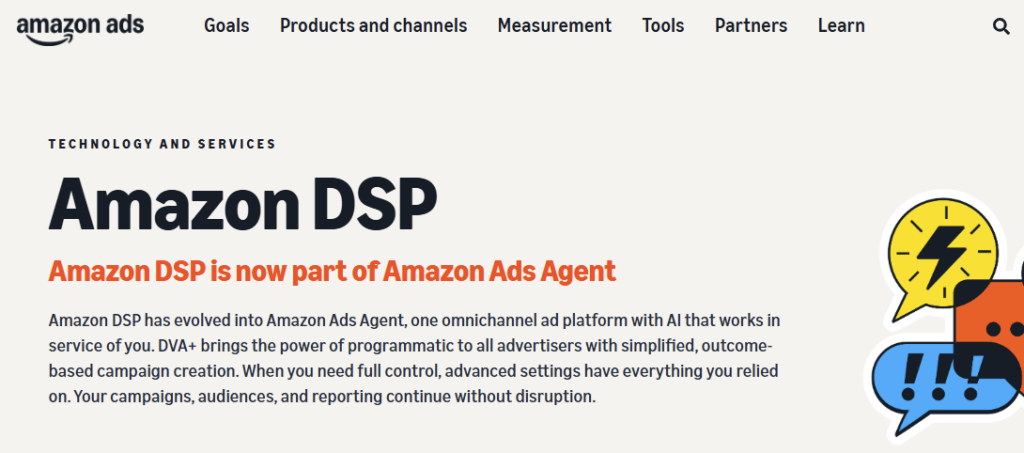
Amazon DSP’s reliability comes from the signal, not the interface. Purchase data, Prime Video inventory, Fire TV, and the Amazon-owned supply make it a good option for commerce and CTV in one buy. The self-serve build has improved substantially and is no longer the managed-service-only product agencies remember.
Where Amazon DSP excels
- Closed-loop measurement capabilities that link digital impression exposure directly to product sales on Amazon.
- Premium placement access across high-engagement video assets like Prime Video streaming content and Twitch streams.
- Useful for campaigns where product discovery and purchase activity matter.
Where Amazon DSP falls short
- Its strongest audience advantage is tied to Amazon’s shopping and media ecosystem.
- Teams that want to compare performance across several external platforms will still need a wider reporting setup.
Who Amazon DSP is best for
- Agencies serving e-commerce, retail, and consumer brands that want access to Amazon’s shopping data and advertising inventory.
5. Yahoo DSP: For Omnichannel buying and premium inventory
Yahoo DSP gives agencies access to programmatic inventory across display, video, audio, CTV, and other channels. It also draws on Yahoo’s own audience data, including information from its content, search, and commerce properties, for campaign planning and targeting
Where Yahoo DSP excels
- Combines Yahoo’s first-party audience data with other identity solutions.
- Supports campaigns across multiple channels such as CTV and DOOH.
- Includes campaign optimization, reporting, and API access.
Where Yahoo DSP falls short
- Teams may need to compare its inventory and integrations with their existing DSP setup.
- Agencies that do not need Yahoo’s audience and identity solutions may find less reason to choose it over other independent DSPs.
Who Yahoo DSP is best for
- Agencies that want to use Yahoo’s audience data and teams running campaigns across display, video, CTV, and other channels.
6. Viant: For Household targeting and connected TV

Viant is especially known for its work in TV and advertising at the household level. It allows agencies to plan and run campaigns on different screens. Viant uses identity and audience data to link advertising actions across connected devices.
Where Viant excels
- Offers household-level audience targeting.
- Supports cross-device advertising and measurement.
- Has a strong focus on CTV and streaming campaigns.
Where Viant falls short
- Its household identity approach may be less useful for campaigns that do not require household-level targeting.
- Teams looking for broader agency workflow management may need additional software.
Who Viant is best for
- Agencies running CTV and streaming campaigns and teams working with household-level audience strategies.
7. Basis: For agency workflow management and media buying
Basis goes beyond media buying. It includes a DSP along with search, direct media buying, campaign planning, and billing, all in one platform. This makes it a strong choice for agencies that want to handle more of their advertising tasks in one place.
Where Basis excels
- Combines programmatic buying with search, social, and direct media buying.
- Offers campaign planning, reporting, billing, and reconciliation tools.
Where Basis falls short
- Agencies looking only for a specialist DSP may not need its wider toolset.
- Its value depends on how much of the agency’s work can be handled within the platform.
Who Basis is best for
- Mid-sized and larger agencies managing several advertising channels.
8. Google Display & Video 360 (DV360): For the Google ecosystem and video advertising

DV360 is Google’s platform for buying and managing programmatic advertising. It is closely connected to other Google Marketing Platform products and gives agencies access to YouTube inventory, making it a natural option for teams already working within Google’s advertising ecosystem.
Where DV360 excels
- Allows advertisers to access YouTube advertising inventory.
- Combines campaign planning, audience management, creative, and reporting in a single interface.
Where DV360 falls short
- Agencies outside the Google ecosystem may not get the same value from its integrations.
- Some inventory and buying options are subject to Google’s policies and ecosystem.
- Agencies still need separate platforms to manage most paid search and paid social workflows.
Who DV360 is best for
- Agencies already using Google Marketing Platform and teams running substantial YouTube and video campaigns.
9. Criteo: Commerce media and retail advertising
Criteo is best known for commerce advertising and product retargeting. This DSP works with retailers and brands to use shopping data for audience targeting, customer acquisition, and retail media campaigns. Criteo’s focus is on commerce rather than general-purpose programmatic buying.
Where Criteo excels
- Its commerce data is relevant to campaigns focused on product discovery and sales.
- Direct access to large retail media network inventory for on-site and off-site consumer targeting.
Where Criteo falls short
- Its commerce focus may not suit agencies looking for a general-purpose DSP for every client.
- Agencies comparing Criteo competitors say teams managing vast non-commerce campaigns may need another DSP alongside it.
Who Criteo is best for
- Agencies working with ecommerce and retail clients. Teams running product advertising and retargeting campaigns.
If your plan for media focuses a lot on performance-based buying methods, you can also look at Moloco competitors to see how platforms that focus on performance measure up against full-service agency DSPs.
See how NEXUS runs this on your data
Everything in this article runs on NEXUS today. See the Demand-Side Platform page.
How to Choose the Most Reliable DSP for Advertising Agencies
Before running a trial, review how demand side platform works under high auction loads to ensure bid streams execute without dropping requests.
- Score on the seven criteria above, weighted for your agency. An independent shop weights the commercial model and support highest; a scaled trading desk weights throughput and supply path.
- Ask for the numbers in writing before the demo. Uptime SLA, peak QPS, Median bid latency, bidder regions, fee basis, log-level access, report dimension count, data latency. If a vendor is not putting it in an email, they’re not putting it in a contract. NEXUS DSP has a 99.9% uptime SLA, 5M+ peak QPS, and ~100ms median latency.
- Run a parallel test, not a replacement. Two platforms, same audience, same creative, same flight, 30 days. Compare on pricing per outcome after fees, not CPM.
- Check reporting against your client deck. If the dimensions you report on monthly are not native dimensions in the platform, you just bought a manual process. NEXUS DSP provides direct access to ~80 native report dimensions and raw impression-level audit logs.
- Confirm the controls, not the promises. MFA exclusion, domain block lists, ads.txt, and vendors. These are settings you should see in the UI during the demo, not on the roadmap. In NEXUS DSP, these compliance and brand safety controls are fully operational features in the UI, not roadmap promises.
Take Action with the Right Agency DSP: NEXUS DSP
Juggling rigid spend minimums, hidden vendor margins, and limited log-level access is a losing game for media buying teams. While your ad operations team spends hours trying to make sense of invoices and dealing with manual fixes for campaigns, uncollected platform fees keep eating into your agency’s profits.
For scalability, you need the most reliable DSP for advertising agencies that replaces restrictive enterprise contracts with a high-throughput, transparent bidding infrastructure. Secure clean supply paths and real-time operational control mean your client campaigns deliver while your agency margins are protected.
As a full-stack advertising OS built specifically for media teams, NEXUS DSP provides 5M+ QPS scale, ~100ms median bid latency, and multi-region 99.9% uptime reliability.
Request Access and compare the NEXUS DSP yourself.
Takeaways
- Keep these in mind when evaluating the most reliable DSP for advertising agencies:
- For an agency, reliability means uptime, throughput, disclosure, and reporting. A platform that fails on disclosure is unreliable regardless of its SLA.
- Most DSPs do not publish throughput, latency, or fee structure. Treat disclosure itself as a scoring criterion.
- The Trade Desk leads on CTV supply. Google DV360 leads on inventory privilege. Amazon DSP leads on commerce signal. All three carry structural trade-offs for agencies.
- NEXUS DSP is a strong option for large agencies and brands, as well as mid-sized agencies: 99.9% uptime SLA, 5M+ peak QPS, ~100 ms median latency, multi-region, 7 channels, 70+ SSP integrations, 6 targeting dimensions, 4 identity solutions, and ~80 report dimensions.
Frequently asked questions
The best DSP for advertising agencies depends on agency size and spend. Enterprise holding companies tend to use The Trade Desk for scale, while large agencies and brands that need reliable infrastructure and full transparency choose NEXUS DSP for its 99.9% uptime SLA, disclosed fee structure, and impression-level audit logs.
The Trade Desk and Google’s DV360 hold the top DSPs by market share in global ad spend volume. However, independent agencies increasingly adopt specialized demand side platform companies like NEXUS for higher platform responsiveness and clear margin structures.
Agencies choose a DSP by testing supply path transparency, native report dimensions, cookieless identity options, and bid latency. Media leads confirm technical specs like peak QPS, while agency owners ensure transparent take rates to protect margins.
Self-serve platforms give agency buyers full hands-on control to set up campaigns, set bidding rules, and get reporting. Managed-service DSPs operate flights using the vendor’s own staff. NEXUS DSP is self-serve, with automated AI optimization workflows.
For small agencies with limited budgets, self-serve platforms like StackAdapt are usually the best DSP for independent agencies, thanks to fast onboarding and no published minimums. NEXUS DSP is built for large agencies and brands, as well as independent agencies with substantial budgets that need transparent fees and impression-level audit logs.



Request access to NEXUS
See how this runs on your own data. Request access to get started.
Request Access